Half-life graphs and alpha decay
AC9S9U06
By the end of this page you should be able to
- Read the half-life of a radioisotope from a decay graph.
- Describe the trend in a decay graph using data.
- Explain what happens in alpha decay, with working and a diagram.
New to half-life? Start with Half-life and carbon dating, then come back.
Reading half-life from a graph
The half-life is the time it takes for half of a radioactive sample to decay. On a graph of mass (or number of atoms) against time:
- Read the starting amount (where the curve meets the vertical axis).
- Halve it.
- Go across from that value to the curve.
- Go down to the time axis and read the time. That is the half-life.
Check: halve again. The next half should take the same time again.
Try it: read the graph
Pick a radioisotope (all half-lives are real). Drag the time slider and watch the mass. Then try the mystery isotope: read its half-life yourself.
Worked example: reading a half-life from a graph
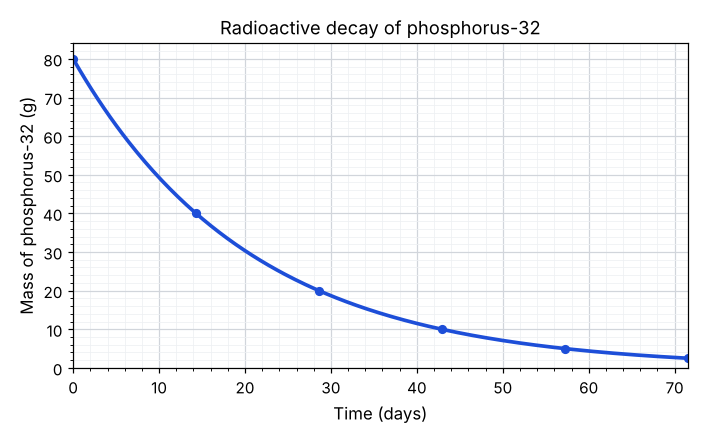
Identify the half-life of phosphorus-32 from the graph.
- Start: 80 g. Half of 80 g is 40 g.
- Across from 40 g to the curve, then down: about 14 days.
- Check: half of 40 g is 20 g, reached at about 28–29 days, another 14 days later. ✓
Answer: the half-life of phosphorus-32 is about 14 days (the accepted value is 14.3 days).
Describing the trend
What a full answer includes: "Interpret the relationship (trend) between the variables"
- Name both variables and the direction: "As time increases, the mass of … decreases."
- Name the shape: an exponential decay (a negative, non-linear relationship): it falls quickly at first, then more and more slowly, and never quite reaches zero.
- Use data: quote values, e.g. it halves every … days (80 g → 40 g → 20 g).
- Give the reason: radioactive decay: in each half-life, half of the remaining unstable nuclei decay.
Worked example: describing the trend in a decay graph
Interpret the relationship between the variables in the phosphorus-32 graph above.
- As time increases, the mass of phosphorus-32 decreases.
- It is an exponential decay: the mass falls quickly at first (40 g lost in the first 14 days) and then more slowly (only 10 g lost between 29 and 43 days).
- The mass halves about every 14 days: 80 g → 40 g (14 days) → 20 g (29 days) → 10 g (43 days). So the half-life is about 14 days.
- This happens because of radioactive decay: in each half-life, half of the phosphorus-32 nuclei that are left decay into another element (sulfur-32).
Alpha decay
An unstable nucleus can become more stable by giving off radiation. In alpha decay it throws out an alpha particle: 2 protons and 2 neutrons (the same as a helium nucleus, 42He). Alpha decay happens in heavy nuclei with too many protons and neutrons.
- The atomic number goes down by 2 (2 protons lost), so the atom becomes a new element.
- The mass number goes down by 4 (2 protons + 2 neutrons lost).
The starting atom is the parent; the new atom is the daughter. Both sides of the equation must balance: the top numbers add up, and so do the bottom numbers.
| Radiation | What it is | Atomic number | Mass number | Stopped by |
|---|---|---|---|---|
| Alpha (α) | 2 protons + 2 neutrons | −2 | −4 | paper or skin |
| Beta (β) | a fast electron from the nucleus | +1 | no change | a few mm of aluminium |
| Gamma (γ) | high-energy electromagnetic radiation | no change | no change | thick lead or concrete (reduced, not fully stopped) |
Try it: step through an alpha decay
Worked example: alpha decay of radium-226
Explain what happens when radium-226 undergoes alpha decay. Show full working and a diagram.
Working
- Radium's atomic number is 88 (periodic table), so radium-226 is 22688Ra.
- It gives off an alpha particle, 42He.
- Mass number: 226 − 4 = 222. Atomic number: 88 − 2 = 86.
- Atomic number 86 is radon (Rn).
22688Ra → 22286Rn + 42He
Check: top 226 = 222 + 4 ✓; bottom 88 = 86 + 2 ✓.
Diagram (sketch it like this):
Explanation: radium-226 is unstable. Its nucleus gives off an alpha particle (2 protons and 2 neutrons). It loses 2 protons, so its atomic number drops from 88 to 86 and it becomes a different element, radon. It loses 4 particles in total, so its mass number drops from 226 to 222. Radium-226 has become radon-222.
Self-check
How this works
Pick or type an answer to get feedback. Nothing is saved or sent anywhere; this is just for you.
1. A radioactive sample starts at 200 g. After 30 minutes, 100 g is left. What is the half-life?
2. Polonium-210 (atomic number 84) undergoes alpha decay. What is the mass number of the daughter?
Worked solution
210 − 4 = 206. Atomic number 84 − 2 = 82: lead. Polonium-210 → lead-206 + alpha particle.
3. Thorium-230 (atomic number 90) undergoes alpha decay. Which element does it become?
4. Which phrase best describes the shape of a radioactive decay graph?
Want more?
- Half-life and carbon dating: watch 100 atoms decay at random.
- PhET: Build a Nucleus (extension, beyond what you need for the test): build nuclei and watch them decay (PhET Interactive Simulations, University of Colorado Boulder, CC BY 4.0).
- Next: Chemical reactions and conservation of mass