Revision: from DNA to Punnett squares
AC9S10U01 AC9S10I08
By the end of this lesson you should be able to
- Describe how nucleotides, genes, DNA, chromosomes, the nucleus and the cell fit inside each other.
- Explain what a mutation is, what can cause one and when it can be inherited.
- Compare mitosis and meiosis.
- Use a Punnett square to predict genotype ratios, phenotype ratios and % chances for one trait.
Hook
Two-minute brain dump. You learned genetics last term. Before you look at anything, write down every genetics word and idea you can remember: DNA, genes, alleles, Punnett squares, anything.
Then swap with a partner. Tick the ideas you both have. Circle anything only one of you wrote. Those circled ideas are where today's revision starts.
Optional: the video below is a fast recap of Mendel's peas and Punnett squares.
Watch: Heredity: Crash Course Biology #9 · Crash Course
Zoom in: from a cell to a nucleotide
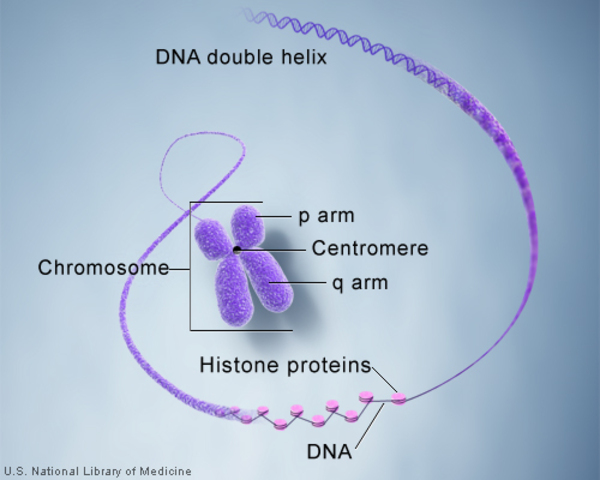
Each structure is part of the next one up. Read the boxes from left to right and you are zooming in.
The U.S. National Library of Medicine's illustration shows how DNA is packed into a chromosome. A chromosome has a short p arm and a long q arm, joined at the centromere. It is made of DNA wrapped around proteins called histones.
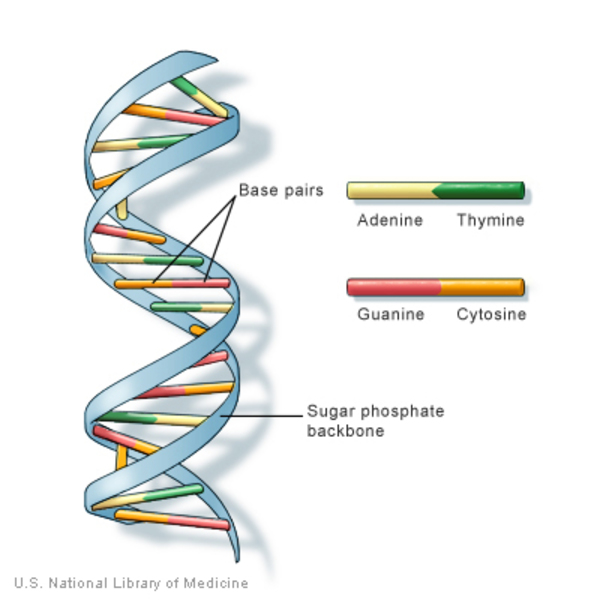
Zoom in further and the DNA is a double helix: a twisted ladder. The sides of the ladder are the sugar–phosphate backbone, and each rung is a base pair (A with T, C with G).
- A chromosome is one long DNA molecule coiled tightly around proteins.
- A gene is a section of DNA that codes for one protein.
- A nucleotide is one building block of DNA: a phosphate, a sugar and one base (A, T, C or G).
Memory trick: say it biggest to smallest as a sentence. "A cell has a nucleus, which holds chromosomes, each made of one DNA molecule, which has many genes, each made of many nucleotides."
Mutations
A mutation is a permanent change in the sequence of bases in DNA.
- Types: a base can be swapped for another (substitution), added (insertion) or lost (deletion). Bigger mutations change part of a chromosome, or a whole chromosome is extra or missing.
- Causes: random mistakes when DNA is copied before a cell divides, and mutagens such as UV light, X-rays and some chemicals (for example in tobacco smoke).
- Effects: most are neutral (no effect). Some are harmful (for example, causing a genetic disorder or cancer). A few are helpful (for example, the mutation that lets some adults digest the sugar in milk).
Inherited or not? Only a mutation in a gamete (sperm or egg), or in the cells that make gametes, can be passed to children. A mutation in a skin cell caused by sunburn can lead to skin cancer, but it is not inherited.
Mitosis vs meiosis
Both are ways a cell divides. Learn the table: most questions about them are answered from one row of it.
| Mitosis | Meiosis | |
|---|---|---|
| Purpose | growth, repair, replacing cells (and asexual reproduction) | making gametes (sperm and eggs) for sexual reproduction |
| Number of divisions | 1 | 2 |
| Cells produced | 2 | 4 |
| Chromosome number | same as the parent cell (human: 46 → 46) | half the parent cell (human: 46 → 23) |
| Identical or varied? | identical to the parent cell and each other | all genetically different from each other |
| Where (in humans) | body cells all over the body | only in the ovaries and testes |
Meiosis makes variety because chromosome pairs are shuffled and swap sections (crossing over). That is why siblings with the same parents are not identical (unless they are identical twins).
Key terms and the Punnett square method
| Term | Meaning | Example (pea height) |
|---|---|---|
| allele | a different version of the same gene | T (tall) or t (short) |
| genotype | the pair of alleles an organism has | TT, Tt or tt |
| phenotype | the trait you can observe | tall or short |
| homozygous | two identical alleles (also called pure-breeding) | TT or tt |
| heterozygous | two different alleles | Tt |
| dominant | shows in the phenotype even with only one copy | T |
| recessive | only shows when there are two copies | t (only tt is short) |
The method, every time:
- Key: choose a letter. Capital = dominant allele, lower case = recessive allele.
- Parents' genotypes: write each parent's two alleles. Use clues like "pure-breeding" (homozygous) or "has a parent with the recessive trait" (must carry one recessive allele).
- Gametes: each parent passes on one allele per gamete (meiosis). Put one parent's alleles across the top and the other's down the side.
- Fill the square, then count: each box is a 1 in 4 (25%) chance for each child.
- Answer the question asked: genotype ratio, phenotype ratio or % chance, with words, not just letters.
Ratio or %? 3 boxes out of 4 = a ratio of 3:1 = 75%. The % is the chance for each child. It does not mean exactly 3 of every 4 children will have that trait, just as flipping a coin twice does not always give one head.
Worked example: fruit-fly wings
In fruit flies, normal wings (V) are dominant to short, crumpled vestigial wings (v). Two flies, both heterozygous for normal wings, are crossed. Give the genotype ratio, the phenotype ratio and the % chance that an offspring has vestigial wings.
1. Key: V = normal wings (dominant), v = vestigial wings (recessive).
2. Parents: both heterozygous, so Vv × Vv.
3. Gametes: each parent makes V or v gametes.
| V | v | |
| V | VV | Vv |
| v | Vv | vv |
4. Count: VV 1, Vv 2, vv 1.
5. Answer: genotype ratio 1 VV : 2 Vv : 1 vv. Phenotype ratio 3 normal : 1 vestigial. Only vv has vestigial wings, so the chance is 1 in 4 = 25%.
Thinking to copy: a vestigial-winged fly needs a v from both parents. Both parents have normal wings but are hiding a v.
Write a question for your partner
Revision is stronger when you make a question, not just answer one.
- Pick any organism and one trait (a plant, an animal, a made-up alien). Decide which allele is dominant.
- Choose the parents' genotypes and write the question. Ask for one % chance.
- Solve it yourself on the back of the page.
- Swap with a partner. Solve theirs, then check each other using the five steps. Did they write the parents' genotypes before drawing the square?
Guided example
Simplified textbook model: free earlobes (E) are dominant to attached earlobes (e). Two parents both have free earlobes. Their first child has attached earlobes. What is the chance their next child has attached earlobes?
Prompts: First write the child's genotype. Then ask: which allele must each parent have given? Then write each parent's genotype, draw the square and count.
Show answer
Child: attached is recessive, so the child is ee. One e came from each parent.
Parents: both have free earlobes, so each has at least one E. Each also gave an e, so both are Ee.
| E | e | |
| E | EE | Ee |
| e | Ee | ee |
1 box out of 4 is ee, so the chance is 25% for each child. The first child having attached earlobes does not change the chance for the next one.
Note: real earlobe shape is controlled by many genes. This one-gene model is used in textbooks because it is simple.
Self-check
How this works
Pick an answer to get feedback. Nothing is saved or sent anywhere; this is just for you.
1.
Which statement about genes and chromosomes is correct?
Explanation
A chromosome contains one long DNA molecule packaged with proteins. Genes are sections of that DNA, and the DNA is built from nucleotides. In plant and animal cells, chromosomes are in the nucleus.
2.
A gardener gets a mutation in a skin cell on her arm after years of sunburn. Which statement is correct?
Explanation
Mutation = a permanent change in the DNA base sequence. It is inherited only if it is in a gamete. Effects can be harmful, neutral or helpful.
3.
Which description matches meiosis?
Explanation
Meiosis: 2 divisions → 4 cells → half the chromosomes → all genetically different. Mitosis: 1 division → 2 cells → same number → identical.
4.
In tomato plants, red fruit (R) is dominant to yellow fruit (r). A heterozygous red plant (Rr) is crossed with a homozygous red plant (RR). What % of the offspring are expected to be heterozygous? (Type a number only.)
Worked solution
Rr × RR gives RR, RR, Rr, Rr. 2 boxes out of 4 are Rr = 50%. (All the offspring have red fruit, because every one gets an R from the RR parent.)
5.
A pea plant is described as pure-breeding for tall stems (tall, T, is dominant). What is its genotype?
Explanation
Pure-breeding = homozygous. For a dominant trait that means two capital letters (TT); for a recessive trait, two lower case (tt).
Exam skill: Punnett squares and % chance
What a full answer includes
- a key: which letter is dominant and which is recessive
- both parents' genotypes, worked out from the clues
- the gametes each parent can make (along the top and side of the square)
- a completed Punnett square
- the answer to the exact question asked (genotype ratio, phenotype ratio or % chance)
Worked example
Worked example. In pea plants, round seeds (R) are dominant to wrinkled seeds (r). Two plants, both heterozygous for seed shape, are crossed. What % of the seeds are expected to be round?
Key: R = round, r = wrinkled. Parents: both heterozygous, so Rr × Rr.
| R | r | |
| R | RR | Rr |
| r | Rr | rr |
Count: 1 RR, 2 Rr, 1 rr. Genotype ratio 1 RR : 2 Rr : 1 rr. Phenotype ratio 3 round : 1 wrinkled.
Answer: RR and Rr are both round (one R is enough), so 3 out of 4 are round: 75%. (Wrinkled = 25%.)
Guided (use the prompts)
2.
In fruit flies, normal wings (V) are dominant to short, crumpled vestigial wings (v). A female with vestigial wings is crossed with a male with normal wings. The male's mother had vestigial wings.
Prompts: First work out the female's genotype (vestigial is recessive). Then ask: which allele must the male have got from his vestigial-winged mother? Put each parent's gametes along the top and side, then fill in the offspring.
blue = gametes from the male (father) · pink = gametes from the female (mother)
Order rule: put the capital letter before the lower-case letter, and X before Y.
Worked solution
The female has vestigial wings, so she is vv: her gametes are v and v. The male has normal wings, so he has at least one V. His mother was vv, so she gave him a v: he is Vv, and his gametes are V and v.
Offspring: 2 Vv (normal wings) and 2 vv (vestigial wings), a 1 : 1 ratio.
Guided (use the prompts)
3.
From the same cross (female vv × male Vv): what is the % chance that an offspring fly has normal wings? (Type a number only.)
Prompt: count the boxes with at least one V.
Worked solution
2 boxes (Vv, Vv) out of 4 contain a V, so 50%.
Your turn
4.
In cattle, polled (hornless, P) is dominant to horned (p). A farmer crosses a heterozygous polled bull with a heterozygous polled cow. Complete the Punnett square.
blue = gametes from the bull · pink = gametes from the cow
Order rule: put the capital letter before the lower-case letter, and X before Y.
Worked solution
Both parents are Pp, so each makes P and p gametes. Offspring: 1 PP, 2 Pp, 1 pp.
Your turn
5.
Use your square for the same cattle cross (Pp × Pp). Out of every 4 calves:
Genotype ratio: PP : Pp : pp
Phenotype ratio: polled : horned
Worked solution
Genotype ratio 1 PP : 2 Pp : 1 pp. PP and Pp both have a P, so they are polled: phenotype ratio 3 polled : 1 horned.
Your turn
6.
For the same cattle cross (Pp × Pp), what is the % chance that any one calf is horned? (Type a number only.)
Worked solution
Only pp is horned: 1 box out of 4 = 25%. (Polled is 75%.)
Your turn
7.
In pea plants, purple flowers (A) are dominant to white flowers (a). A pure-breeding purple plant is crossed with a white plant. What % of the offspring are expected to have white flowers? (Type a number only.)
Worked solution
Pure-breeding purple = AA; white = aa. Every offspring gets A from one parent and a from the other, so all are Aa (purple). White = 0%. Watch for "pure-breeding": it tells you the genotype is homozygous.
Your turn
8.
Extension (harder). From the Pp × Pp cattle cross, a farmer picks a calf that is polled. What is the chance that this calf is heterozygous (Pp)?
Explanation
We already know the calf is polled, so cross out the horned box (pp). That leaves 3 boxes: PP, Pp, Pp. 2 of these 3 are heterozygous: 2 ÷ 3 ≈ 67%.
Exit questions
- Define phenotype and give one example.
- Give two differences between mitosis and meiosis.
- A horned bull (pp) is crossed with a pure-breeding polled cow (PP). What % of their calves will be horned? Show the genotypes.
Show answers
- The phenotype is the trait you can observe, which results from the genotype (and sometimes the environment), e.g. tall stems, vestigial wings, attached earlobes.
- Any two: mitosis has 1 division, meiosis 2; mitosis makes 2 cells, meiosis 4; mitosis keeps the chromosome number (46 → 46), meiosis halves it (46 → 23); mitosis cells are identical, meiosis cells are all different; mitosis is for growth and repair, meiosis makes gametes.
- pp × PP: every calf gets p from the bull and P from the cow, so all calves are Pp (polled). Horned = 0%.