Practical: can light tell us what stars are made of?
AC9S10U03 AC9S10H02 AC9S10I05
By the end of this lesson you should be able to
- Use a spectroscope safely to observe continuous and line spectra.
- Describe the difference between continuous, emission and absorption spectra.
- Explain how electrons moving between energy levels produce lines of particular colours.
- Match dark lines in the Sun's spectrum to elements, and explain how helium was found in the Sun before it was found on Earth.
Hook
Back to the conspiracy board. Last lesson we busted the size of Earth, the distance to the Sun and the distance to the stars. One claim survived:
"We know what stars are made of." (Nobody has ever brought a sample home.)
In 1835 the French philosopher Auguste Comte said we would never know what stars are made of. Less than 30 years later, scientists had worked it out, without leaving Earth.
Here is the strangest part of the story. In 1868, astronomers studying light from the Sun during a solar eclipse saw a bright yellow line that matched no element known on Earth. They named the new element helium, after helios, Greek for Sun. Helium was not found on Earth until 1895, 27 years later.
Today's question: how can a line of coloured light tell you what something is made of? You will split light yourself and find out.
Watch: Light: Crash Course Astronomy #24 · Crash Course
The practical
To observe the spectra of different light sources with a handheld spectroscope, and to decide whether each one is a continuous spectrum (a smooth rainbow), a line spectrum (separate bright lines) or a mix of both.
A spectroscope is a tool that splits light into its colours. Inside it is a diffraction grating: a clear sheet with thousands of tiny, evenly spaced lines that spread light out like a prism does.
Question: Do all light sources give the same spectrum? Can the spectrum be used to tell which gas is glowing inside a tube?
You will need:
- handheld spectroscopes or diffraction grating glasses/slides (one per pair)
- incandescent (filament) light bulb in a lamp
- white LED torch or lamp
- fluorescent tube or compact fluorescent lamp
- gas discharge (spectrum) tubes, e.g. hydrogen, helium, neon, and the spectrum tube power supply (teacher-operated only)
- sheet of white paper (for reflected sunlight or daylight, optional)
- coloured pencils
- printed or projected copy of the reference spectra (Making sense tab)
Safety
- Spectrum tube power supply uses very high voltage (thousands of volts): Teacher-operated only. Students never touch the power supply, leads or tube holder. The power supply is switched off before any tube is changed.
- Discharge tubes and lamps get hot; glass tubes can break: Do not touch tubes or bulbs. The teacher lets tubes cool before changing them, and uses tubes in an enclosed holder. Report any broken glass; do not pick it up.
- Looking at the Sun, even through a spectroscope, can permanently damage your eyes: NEVER point a spectroscope at the Sun. For sunlight, point it at white paper lit by the Sun or at bright sky well away from the Sun.
- Some lamps (fluorescent, mercury and some discharge tubes) give off a little ultraviolet (UV) light: Glass blocks most UV, but view each source for short periods only (under a minute) and keep about 30 cm or more away.
- Darkened room: trips and bumps: Bags under benches, stools tucked in, stay at your station while the lights are dimmed.
Method
- Practise first. Hold the spectroscope with the slit end towards a light and look through the other end. Turn it until the spectrum appears to the side of the slit, spread out from violet to red.
- Incandescent bulb. Look at the bulb (not too close). In the results table, sketch and colour what you see and decide: continuous, lines or both?
- White LED. Repeat. Look carefully: are all the colours equally bright, or is there a bright blue part?
- Fluorescent tube. Repeat. Look for a few bright lines sitting on top of a fainter rainbow.
- Discharge tubes (teacher-operated). The teacher switches on one tube at a time. Look from your seat or move to the marked viewing spot. For each gas, sketch the bright lines in the right positions and colours.
- Optional: sunlight. Point the spectroscope at white paper in sunlight (never at the Sun). With a good spectroscope you may see a few thin dark lines across the rainbow.
- Return all spectroscopes, then go to the Making sense tab.
Results
| Light source | Sketch / colours seen (violet on the left, red on the right) | Continuous, lines or bands? |
|---|---|---|
| Incandescent bulb | ||
| White LED | ||
| Fluorescent tube | ||
| Hydrogen tube | ||
| Helium tube | ||
| Neon tube | ||
| Other tube: ________ | ||
| Sunlight on white paper (optional) |
Making sense of it
Why do glowing gases give lines?
Electrons in an atom can only have certain amounts of energy, called energy levels. Think of a ladder: you can stand on a rung, but not between rungs.
- When an atom absorbs energy (from heat or electricity), an electron jumps up to a higher level.
- When the electron drops back down, the atom gives out that energy as light. The size of the drop decides the colour: a big drop gives violet or blue light, a small drop gives red light.
- Each element has its own set of levels, so it gives out its own set of colours. The pattern of lines is the element's fingerprint.
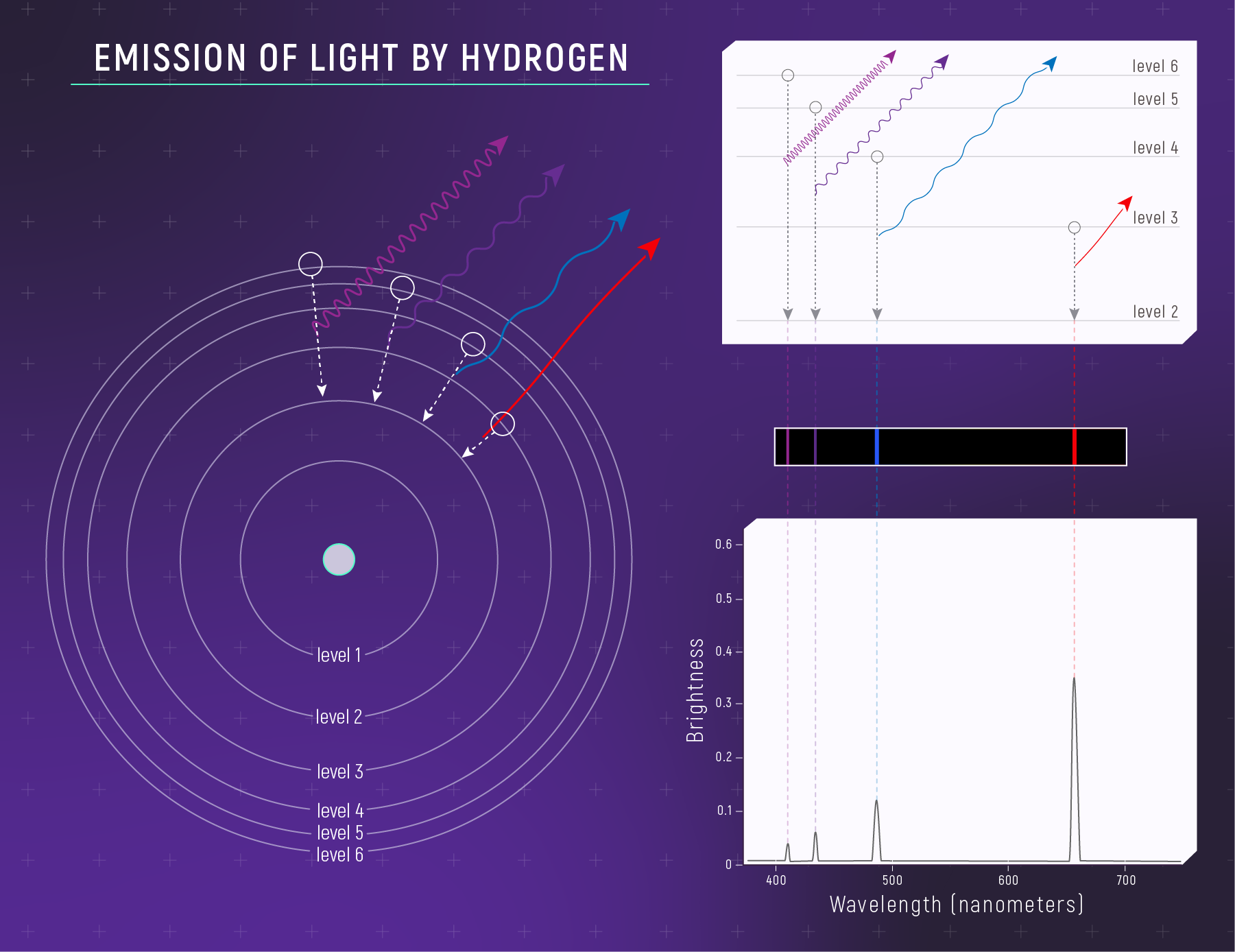
Hydrogen's four visible lines are at 410, 434, 486 and 656 nm. The biggest of these four drops gives violet light (410 nm); the smallest gives red light (656 nm).
Three kinds of spectrum
- Continuous spectrum: a smooth rainbow with no gaps. Made by a hot, dense object such as a bulb filament or the inside of a star.
- Emission spectrum: bright coloured lines on a dark background. Made by a hot, thin gas (like your discharge tubes).
- Absorption spectrum: a rainbow with thin dark lines missing. Made when white light passes through a cooler gas. The gas absorbs exactly the colours it would emit, so the dark lines are in the same places as that gas's bright lines.

Look at where you stand in the diagram: looking at the star through the cloud gives the absorption spectrum; looking at the glowing cloud from the side gives the emission spectrum. The bright lines and the dark lines are at the same colours.
A star's hot inner layers make a continuous spectrum. That light passes through the star's cooler outer layers, which absorb some colours. So starlight is an absorption spectrum, and the dark lines tell us which elements are in the star.
Conspiracy busted: nobody needs a sample. The light brings the evidence to us. Every element has a fixed line pattern that we can measure in a lab on Earth and then find in starlight. That is how we know the Sun is mostly hydrogen and helium.
Questions (answer in your book, then check)
- Which sources gave a continuous spectrum? Which gave lines? What do the line sources have in common?
Show model answer
The incandescent bulb (hot solid filament) gave a continuous spectrum. The white LED looked almost continuous, with an extra-bright blue part. The discharge tubes gave separate bright lines. The line sources all contain a thin, glowing gas.
- Hydrogen and helium tubes both glow, but their lines were in different places. Why?
Show model answer
Each element has a different set of energy levels, so its electrons make different-sized drops and give out different colours. Different line patterns mean different elements.
- The fluorescent tube showed bright lines on top of a faint rainbow. Suggest why. (Hint: the tube contains a little mercury gas and is coated inside with a white powder.)
Show model answer
The mercury gas gives bright lines (including violet, green and yellow). Some of its light (mostly ultraviolet) makes the white coating glow, which gives the fainter, smoother spectrum underneath.
- How is this practical an example of technology enabling science?
Show model answer
Without the spectroscope (a prism or grating) we could not split light into lines and measure where they are. The tool made a whole new kind of evidence possible: chemistry from a distance.
Read the Sun's fingerprint
This is the real spectrum of the Sun. In 1814 Joseph von Fraunhofer mapped hundreds of its dark lines and labelled the strongest ones with letters. Nobody knew what caused them for another 45 years.

Dark lines in sunlight (the lettered lines in the image):
| Fraunhofer's letter | Wavelength of the dark line (nm) |
|---|---|
| A | 759 |
| B | 687 |
| C | 656 |
| D (a close pair, D1 and D2) | 589.6 and 589.0 |
| E | 527 |
| F | 486 |
| G | 431 |
| H | 397 |
| K | 393 |
Reference: bright lines from glowing gases in the lab
| Element (measured in a lab on Earth) | Bright lines (nm) |
|---|---|
| Hydrogen | 410, 434, 486, 656 |
| Helium | 447, 471, 492, 502, 587.6, 668 |
| Sodium | 589.0, 589.6 |
| Mercury | 405, 436, 546, 577, 579 |
| Iron | many lines, including 431 and 527 |
| Calcium (ions) | 393, 397 (and 431 for calcium atoms) |
| Oxygen gas (in Earth's air) | 687, 759 |
- Hydrogen: which two lettered lines match hydrogen's lines? What does that tell you about the Sun?
- The D lines: which element makes this close pair of yellow lines?
- Lines H and K are at the violet end. Which element do they show?
- Lines A and B match oxygen gas. But the light passes through something on its way to us that is full of oxygen. What, and why does this matter?
- 1868: during a solar eclipse, astronomers saw a bright yellow line coming from the Sun's edge at 587.6 nm, very close to the D lines. Why did they decide it was not sodium?
- Claim: complete the sentence "The Sun contains ___, ___ and ___ because ___."
Show answers
1. C (656 nm) and F (486 nm) match hydrogen. Cooler hydrogen in the Sun's outer layers absorbs those colours, so the Sun contains hydrogen. (Hydrogen's 410 and 434 nm lines are in the Sun too; Fraunhofer just did not give them main letters.)
2. Sodium (589.0 and 589.6 nm).
3. Calcium (calcium ions, 393 and 397 nm).
4. Earth's atmosphere. Oxygen in our own air absorbs those colours, so lines A and B are not evidence about the Sun. Scientists check this by seeing that these lines get stronger when the Sun is low in the sky (its light goes through more air). Not every line is what it first seems.
5. Sodium's lines are at 589.0 and 589.6 nm. 587.6 nm is close, but it did not match sodium or any other element known on Earth. So it had to be a new element: they named it helium, after helios, the Sun. It was found on Earth in 1895.
6. e.g. "The Sun contains hydrogen, sodium and calcium because dark lines in sunlight (C and F, the D pair, H and K) are at exactly the same wavelengths as the bright lines these elements give out in the lab." (Iron is also a good answer: lines E and G.)
Self-check
How this works
Pick an answer to get feedback. Nothing is saved or sent anywhere; this is just for you.
1.
Through a spectroscope, a glowing gas tube shows four thin, bright coloured lines on a dark background. What kind of spectrum is this?
Explanation
Continuous = smooth rainbow (hot dense object). Emission = bright lines on dark (hot thin gas). Absorption = dark lines in a rainbow (white light through cooler gas).
2.
Why do atoms of different elements produce different patterns of emission lines?
Explanation
Electrons absorb energy and jump up energy levels, then drop down and emit light. The colour depends on the size of the drop, and each element has its own set of levels.
3.
The table shows the dark lines in the Sun's spectrum, and the lines that some elements make in the lab.
| Source | Lines (nm) |
|---|---|
| Sun's dark lines | 393, 397, 410, 434, 486, 589.0, 589.6, 656 |
| Hydrogen | 410, 434, 486, 656 |
| Sodium | 589.0, 589.6 |
| Calcium ions | 393, 397 |
| Helium | 447, 471, 492, 502, 587.6, 668 |
| Mercury | 405, 436, 546, 577, 579 |
Which statements are supported by these data?
- The Sun contains hydrogen
- The Sun contains sodium
- The lines at 589.0 and 589.6 nm are caused by helium
- The Sun's lines at 393 and 397 nm match calcium ions
- The Sun contains no mercury at all
Show answer
Correct: The Sun contains hydrogen; The Sun contains sodium; The Sun's lines at 393 and 397 nm match calcium ions.
To identify an element, match its whole pattern of lines, not just one line. Sodium's pair (589.0, 589.6 nm) and helium's line (587.6 nm) are close, but not the same. No matching lines means no evidence for that element in these data, which is not the same as proof it is absent.
4.
Helium was identified in the Sun in 1868 but not found on Earth until 1895. How was this possible?
Explanation
This is technology enabling science: the spectroscope turned light into evidence about chemistry, even for objects we can never visit.
Exit questions
- Describe the difference between an emission spectrum and an absorption spectrum.
- Explain, using the words electron and energy level, why a hydrogen tube gives a red line at 656 nm.
- Bust the conspiracy: in two sentences, explain how we know what stars are made of without visiting one.
Show answers
- Emission: bright coloured lines on a dark background (made by a hot, thin gas). Absorption: a full rainbow with dark lines missing (made when white light passes through a cooler gas). For the same element, the lines are in the same places.
- Electrons in hydrogen atoms gain energy and jump to a higher energy level. When an electron drops back down by one particular amount, the atom gives out light of one particular colour, red at 656 nm.
- Each element absorbs and emits its own pattern of colours, which we can measure in a lab. The dark lines in starlight match those patterns, so we can tell which elements are in the star from its light alone.
Want more?
- PhET: Models of the Hydrogen Atom (see electrons jump between levels and the light they give out)
- Crash Course Astronomy #24: Light