The Great Conspiracy: how do we know?
AC9S10U03 AC9S10H02 AC9S10I05
By the end of this lesson you should be able to
- Explain the difference between a scientific theory, a guess and a conspiracy theory.
- Describe how Eratosthenes used shadows to measure Earth.
- Explain why the transit of Venus mattered so much in the 1700s, and why observers had to be far apart.
- Explain what a light-year is and why telescopes see into the past.
Hook
WARNING: the following "facts" are part of a global conspiracy by Big Science and Big Maths. 🙄
- The Earth is round. (Sure. Did YOU check?)
- Jupiter has a mass of about 1.9 × 1027 kg. (Who put it on the scales?)
- The Sun is about 150 million km away. (Who held the tape measure?)
- Some stars are thousands of light-years away. (A light-year? Is that a time or a distance? Suspicious.)
- We know what stars are made of. (Nobody has ever brought a sample home.)
- Telescopes can see into the past. (Time travel. Obviously.)
- There are photos of our whole galaxy, the Milky Way. (Who took them? From where?)
- The universe is about 13.8 billion years old. (Nobody was there.)
Your mission: pick the claim you think is the hardest to prove. With a partner, suggest one way someone could test it without leaving Earth. A wrong idea that can be tested is better than no idea.
Watch: Distances: Crash Course Astronomy #25 · Crash Course
Theory, guess or conspiracy?
In everyday talk, "it's just a theory" means "it's just a guess". In science the word means the opposite.
- A guess is an idea with no evidence yet.
- A scientific theory is a well-tested explanation. It is supported by many lines of evidence and it makes predictions that can be checked.
- A conspiracy theory explains away the evidence ("they faked it") and cannot be tested, because any evidence against it is called part of the cover-up.
Key idea: you do not have to believe scientists. You can check how they know: what was measured, and what was predicted.
Measuring the Earth with two sticks
Around 240 BCE, Eratosthenes heard that at noon on midsummer's day the Sun shone straight down a well in Syene, Egypt. A stick there cast no shadow. On the same day in Alexandria, about 800 km north, a stick did cast a shadow: the Sun was 7.2° away from straight overhead.
Sunlight arrives in parallel rays. The only way the two shadows can differ is if the ground is curved. The 7.2° is also the angle between the two cities measured at Earth's centre.

In the diagram, θ is the shadow angle (7.2°) and s is the distance between the cities. Eratosthenes measured s in stades, an ancient Greek unit; historians still argue about exactly how long a stade was, so we use the modern distance of about 800 km.
Worked example: how big is the Earth?
7.2° is what fraction of a full circle? Use it to estimate Earth's circumference.
A full circle is 360°. 360 ÷ 7.2 = 50, so the distance between the cities is 1/50 of the way around Earth.
Circumference ≈ 50 × 800 km = 40 000 km.
Check: today's measured value is about 40 000 km around the poles. Two sticks, a shadow and some geometry, more than 2000 years ago.
The transit of Venus: the 1700s space race
Kepler's laws (1609–1619) gave the relative spacing of the planets: Jupiter is about 5.2 times as far from the Sun as Earth. But nobody knew the actual distance in kilometres, so the map of the solar system had no scale.
A transit of Venus is when Venus passes directly between Earth and the Sun, and looks like a small black dot crossing the Sun. Transits come in pairs 8 years apart, then not again for over 100 years.
- 1639: Jeremiah Horrocks and William Crabtree in England were the first to observe one.
- 1716: Edmond Halley showed how to use a transit to find the Earth–Sun distance: observers far apart on Earth see Venus cross the Sun on slightly different paths and at slightly different times. That difference, plus geometry, gives the distance. This shift with viewing position is called parallax.
- 1761 and 1769: Britain, France and other nations sent observers all over the world.
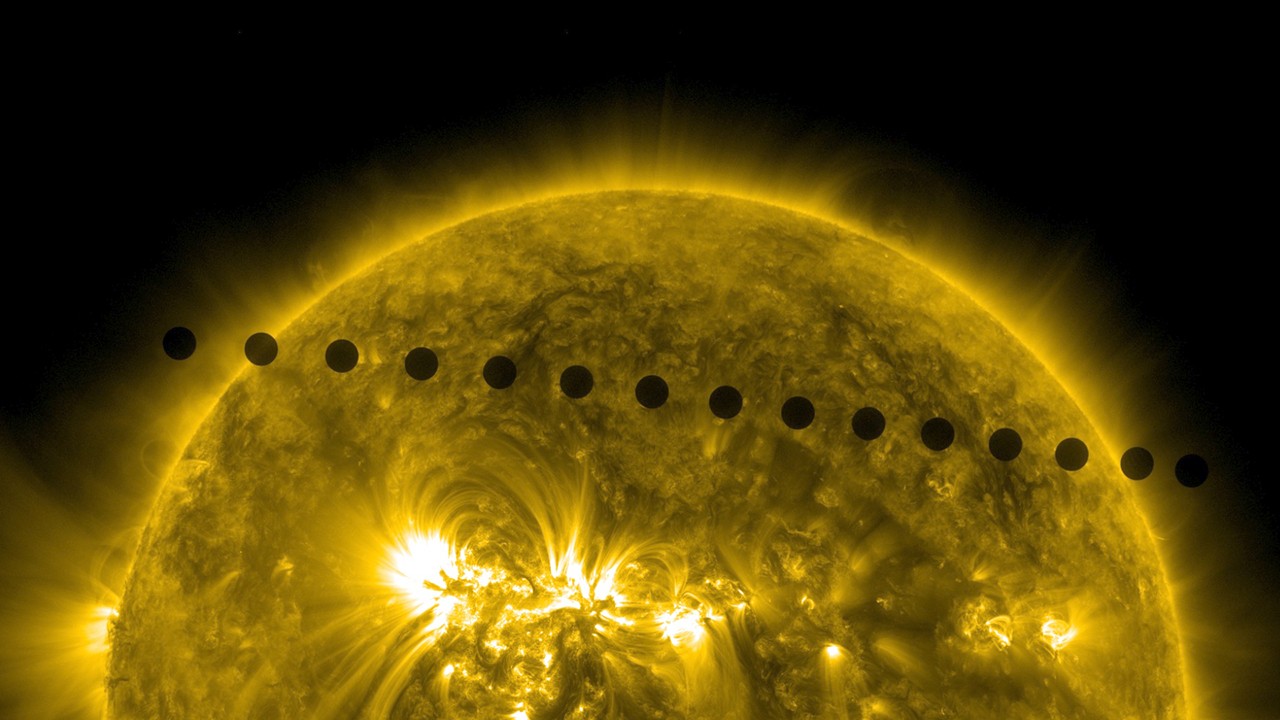
This is the most recent transit, on 5–6 June 2012, photographed from space by NASA's Solar Dynamics Observatory (the next one is in 2117). Each black dot is Venus at a different time. An observer somewhere else would see this path sit very slightly higher or lower on the Sun, and would see it start and finish at slightly different times. Halley's method measures that tiny difference.
The unluckiest astronomer
Guillaume Le Gentil, a French astronomer, sailed for India in 1760 to see the 1761 transit. War delayed him and he was still at sea on the day, on a rolling ship where accurate timing was impossible. He decided to wait 8 years for the next one, and built an observatory at Pondicherry. The skies were clear for weeks beforehand, then clouds covered the Sun for the transit and cleared soon after. He sailed home and reached Paris in 1771, after more than 11 years away, to find he had been declared dead: his relatives had divided up his property and his place at the Academy of Sciences had been filled. He had to go to court to get his life back.
In 1769 Britain sent Lieutenant James Cook on HMS Endeavour to Tahiti with astronomer Charles Green. They observed the whole transit. (The voyage also carried secret orders to search for a southern continent, which led to Cook charting the east coast of Australia in 1770.) Combining results from around the world gave an Earth–Sun distance within a few per cent of today's value of about 150 million km.
Light-years: looking out is looking back
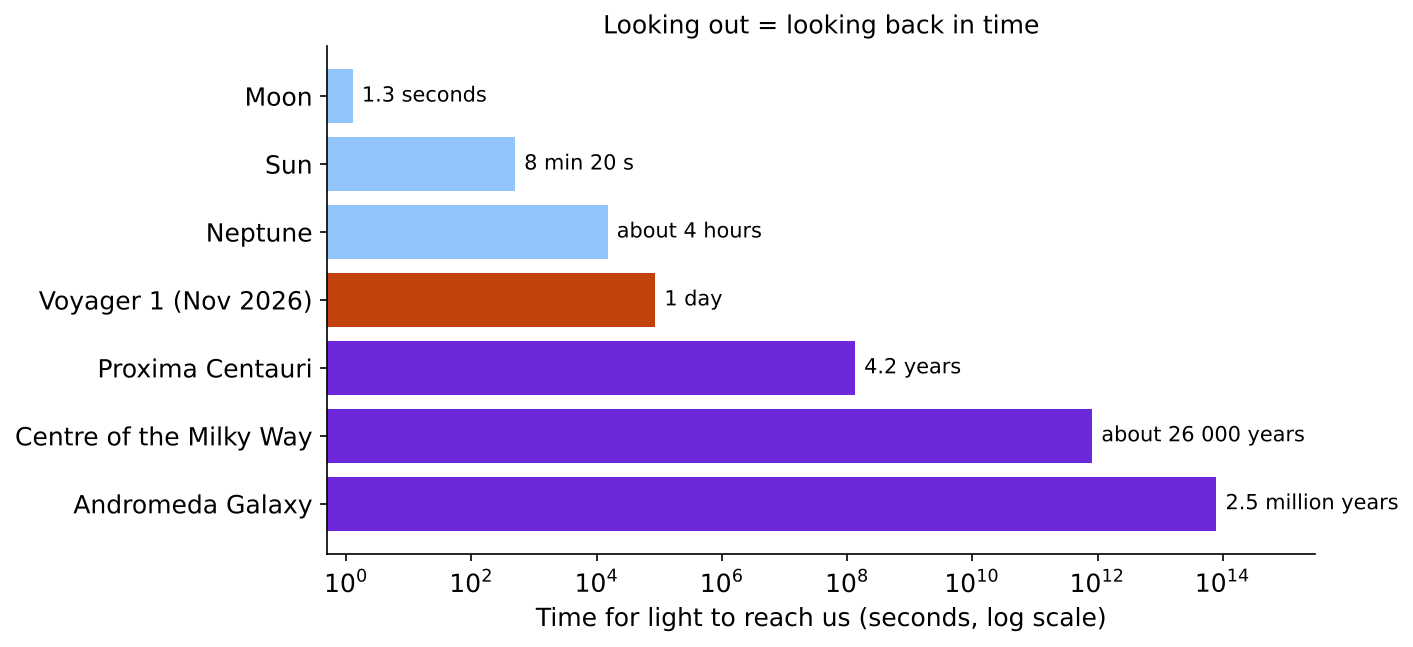
Light is fast (300 000 km every second) but not instant. A light-year is a distance: how far light travels in one year, about 9.46 × 10¹² km (9.46 trillion km).
Because light takes time to reach us, we always see things as they were when the light left them. You see the Sun as it was about 8 minutes 20 seconds ago. On about 18 November 2026, the Voyager 1 spacecraft (launched 1977) becomes the first human-made object to be one light-day away: a radio message takes a full day to reach it.
Distances to stars are measured with the same parallax idea, using Earth's orbit as the baseline. A nearby star seems to shift a tiny amount against very distant stars six months apart, for example in January and July, when Earth is on opposite sides of the Sun. Friedrich Bessel made the first accepted measurement in 1838.

Photos of the whole Milky Way? Nobody has one. We are inside it. Every "photo" of the whole galaxy from outside is an artist's illustration based on measurements of where its stars and gas are, like mapping a forest from the inside.
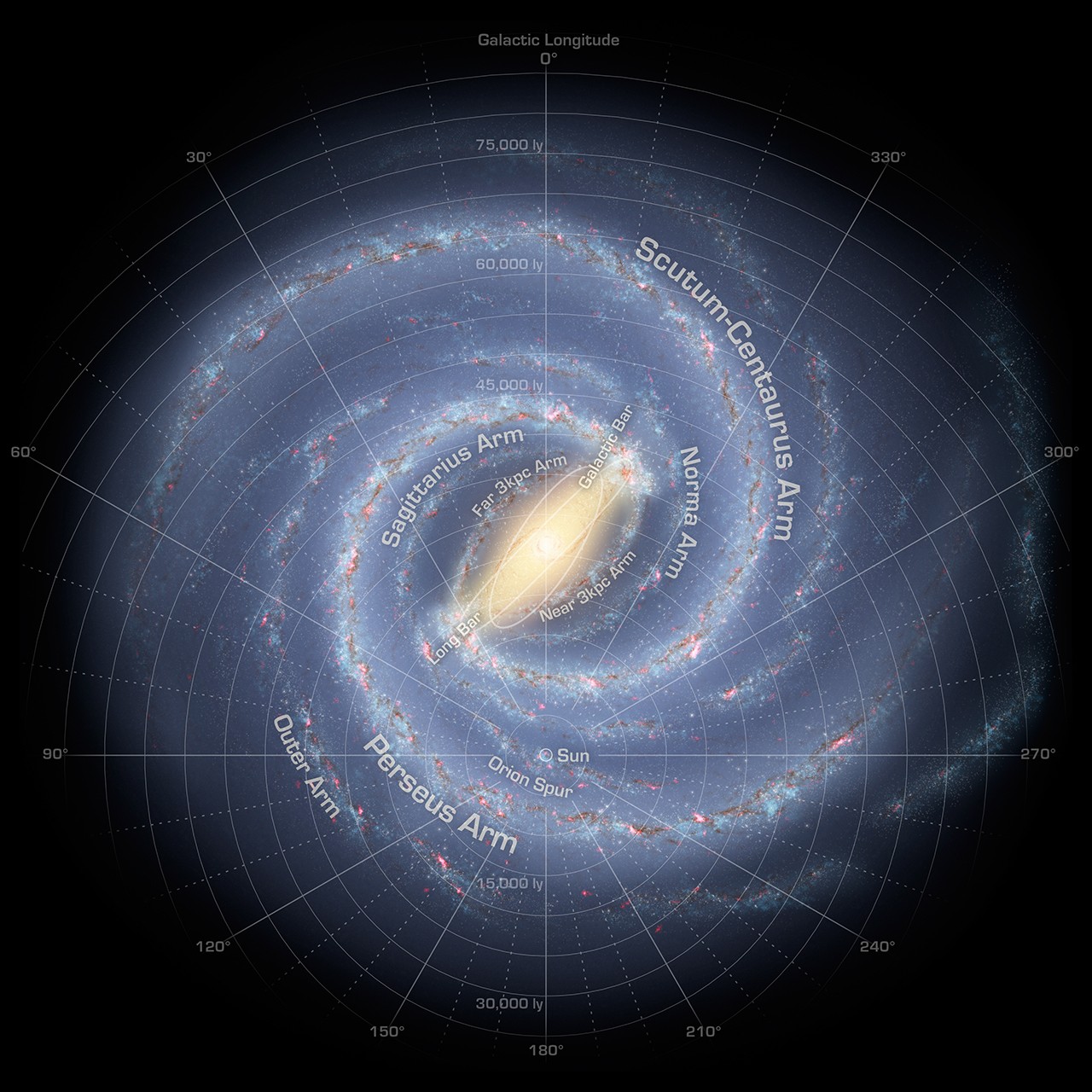
Notice the credit: this is an artist's impression, drawn from measurements made with NASA's Spitzer Space Telescope. It is a careful map, not a photo.
Worked example: how far is a light-year?
Light travels 300 000 km each second. There are about 3.16 × 10⁷ seconds in a year. How far is one light-year?
distance = speed × time = 300 000 km/s × 3.16 × 10⁷ s = 9.48 × 10¹² km.
That rounds to the accepted value of about 9.46 × 10¹² km (the small difference is rounding of the speed of light).
Conspiracy-buster cards
Go back to the eight "conspiracy" claims from the start of the lesson. For each one, write:
- What was measured? (e.g. a shadow angle, a time, a tiny shift in position)
- Who, and roughly when?
- Still a mystery for now? Tick it. We will bust it in a later lesson (what stars are made of, and the age of the universe).
Kepler check: Kepler's third law says the farther a planet is from the Sun, the longer its year (T2 ∝ r3). Mars is about 1.5 times as far from the Sun as Earth. Using T2 ∝ r3, is a Mars year longer or shorter than an Earth year? (It is about 1.9 Earth years.)
Try it
Thumb parallax: hold your thumb up at arm's length. Close one eye, then the other. Your thumb jumps against the background. Now bring your thumb halfway to your face and repeat. Predict first: does a closer thumb jump more or less? What does that tell you about how much nearby stars shift compared with distant ones?
Guided example
Le Gentil was ready in Pondicherry in 1769 but clouds hid the Sun. Why could one observer in one place never have measured the Earth–Sun distance by himself, even with clear skies?
Show answer
The method needs parallax: comparing what two or more observers, far apart on Earth, see at the same time. One observer gives one view of Venus against the Sun. You need a second view from a known distance away to compare paths and timings, then geometry gives the distance. That is why nations sent observers to places as far apart as Tahiti, India, Siberia and Canada, and why accurate clocks and knowing each observer's exact position mattered so much.
Self-check
How this works
Pick an answer to get feedback. Nothing is saved or sent anywhere; this is just for you.
1.
Which statement best describes a scientific theory?
Explanation
In science, a theory is a broad, well-tested explanation supported by many lines of evidence. It makes predictions that can be checked, and it can be changed if new evidence demands it.
2.
Eratosthenes found the shadow angle at Alexandria was 7.2° when there was no shadow at Syene, 800 km away. Assume the Sun's rays are parallel and Syene is roughly due south of Alexandria. What did this tell him?
Explanation
Parallel sunlight + different shadow angles = a curved Earth. The shadow angle equals the angle at Earth's centre between the two places.
3.
Why did astronomers in 1761 and 1769 send observers to places as far apart as possible to watch the transit of Venus?
Explanation
This is parallax: two views from different places, compared using geometry. The wider apart the observers, the more accurate the result.
4.
A star is 500 light-years away. Which statement is correct?
Explanation
A light-year is the distance light travels in a year (about 9.46 × 10¹² km). Looking at distant objects means looking back in time.
Exit questions
- Explain in one sentence why the transit of Venus was so important to astronomers in the 1700s.
- What happened to Guillaume Le Gentil when he finally got home in 1771?
- Which "conspiracy" claim from today is still unbusted? Write one question you want answered in the next lessons.
Show answers
- It was a way to measure the actual Earth–Sun distance in kilometres, which gave the scale for the whole solar system (Kepler's laws only gave relative distances).
- After more than 11 years away he had been declared dead: his relatives had divided his property and his Academy position had been given away. He had to go to court to get them back.
- Likely: what stars are made of, or the age of the universe. Both are answered using light: next lesson (spectroscopy) and the big bang lessons.