The scale of the universe and the life of a star
AC9S10U03 AC9S10I05
By the end of this lesson you should be able to
- Compare the sizes of objects in space using scientific notation.
- Describe the stages in the life of a star from nebula to main sequence.
- Explain why a star's mass decides how it ends, and describe the two paths.
- Explain how supernovae spread the elements that make planets and people.
Hook
Hold up a grain of sand. If the Sun were shrunk to the size of that grain (about 1 mm across):
- Earth would be a speck of dust about 10 cm away.
- The nearest star, Proxima Centauri, would be another grain of sand about 30 km away.
- The Milky Way, our galaxy, would be about 700 000 km across, nearly twice the distance to the Moon.
And every atom of calcium in your bones and iron in your blood was made inside a star that died before the Sun was born.
Think–pair–share (2 min): which of those facts is hardest to believe? What would you want to measure to check it?
Watch: Low Mass Stars: Crash Course Astronomy #29 · Crash Course
The scale ladder
Sizes in space are so different that ordinary numbers stop working. We use scientific notation: a number between 1 and 10 multiplied by a power of ten. Each step up in the power means 10 times bigger.
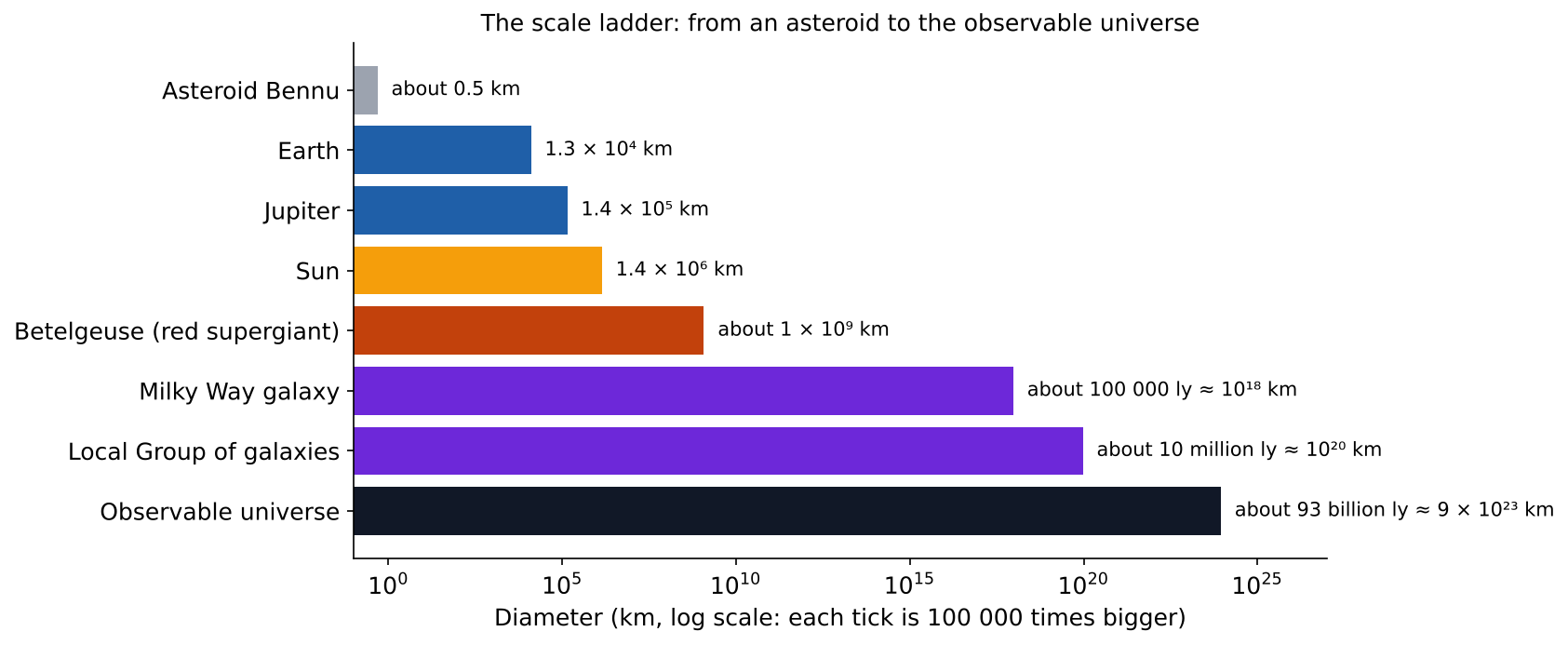
- A planet orbits a star; a star is a huge ball of hot gas that makes its own light.
- A galaxy is a collection of billions of stars, gas and dust held together by gravity.
- Galaxies gather in groups and clusters. The Milky Way belongs to the Local Group, with the Andromeda Galaxy and dozens of smaller galaxies.
- The observable universe is everything whose light has had time to reach us.
Key idea: when the scale has a log axis, each tick is a jump of many times, not a step of the same size. On the chart above the Sun looks close to Jupiter, but it is 10 times wider.
Worked example: how many Earths across the Sun?
Earth is 1.3 × 10⁴ km across. The Sun is 1.4 × 10⁶ km across. About how many Earths would fit across the Sun?
Divide the numbers and subtract the powers: (1.4 ÷ 1.3) × 106 − 4 ≈ 1.1 × 10² ≈ 110 Earths.
Now try: Betelgeuse is about 1 × 10⁹ km across. How many Suns across is that? (1 × 10⁹ ÷ 1.4 × 10⁶ ≈ 700 Suns.)
Birth and the main sequence
Every star starts in a nebula: a huge, cold cloud of gas (mostly hydrogen and helium) and dust.
- Gravity pulls part of the cloud together. As it squeezes in, it heats up. This hot, shrinking ball is a protostar.
- When the centre reaches about 10 million K (kelvin; at these temperatures K and °C are almost the same number), hydrogen nuclei start to join together to make helium. This is nuclear fusion, and it releases huge amounts of energy. A star is born.
- The star is now a main-sequence star. Gravity pulls inwards; the pressure from the hot gas and energy from fusion pushes outwards. The two are in balance, so the star stays the same size for a long time.
Stars spend about 90% of their lives on the main sequence. The Sun is about 4.6 billion years into a main-sequence life of about 10 billion years.
Surprise: bigger stars have shorter lives. A star with more mass has a hotter, more squeezed core, so it burns through its hydrogen much faster. A star 20 times the Sun's mass lasts only about 10 million years.
Two endings: mass decides
When the hydrogen in the core runs low, fusion slows, gravity wins for a while, and the core shrinks and heats up. The outer layers swell and cool. What happens next depends on the star's mass.
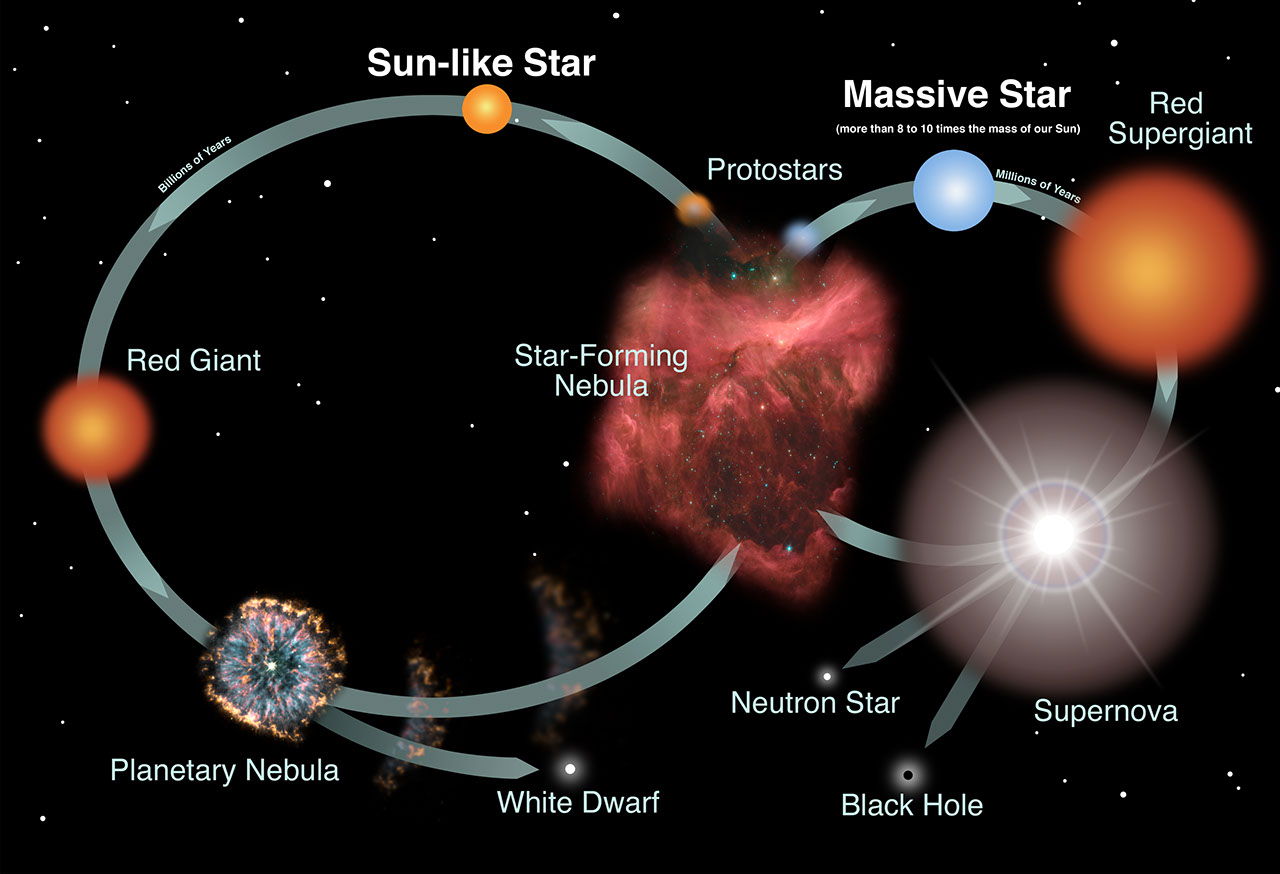
Reading the diagram: the "Sun-like star" and the "massive star" are both main-sequence stars. The diagram does not give a number, but the dividing line is about 8 times the Sun's mass. Notice the arrows back to the star-forming nebula: a dying star's gas is recycled into new stars (section 4).
Low and average-mass stars (like the Sun): the star swells into a red giant. Its outer layers drift away into space as a glowing shell called a planetary nebula (nothing to do with planets; it just looked like one in old telescopes). The core left behind is a white dwarf: about the size of Earth, very hot and dim, slowly cooling for billions of years.
High-mass stars: the star swells into a red supergiant (like Betelgeuse). Its core fuses heavier and heavier elements until it makes iron. Fusing iron does not release energy, so the core suddenly collapses and the star explodes as a supernova, briefly outshining a whole galaxy. What is left is either a neutron star (a city-sized ball of neutrons) or, if the leftover core is heavy enough, a black hole, where gravity is so strong that not even light can escape.
We are made of star stuff
Right after the big bang, the universe had almost only hydrogen and helium. So where did everything else come from?
- Fusion in stars made the elements up to iron: carbon, oxygen, nitrogen, calcium and more.
- Elements heavier than iron need even more energy. Most of the gold and other very heavy elements (such as platinum and uranium) were made in supernovae and in collisions of neutron stars. (Some heavy elements are also built up slowly inside giant stars.)
- These explosions throw the new elements into space. They mix into new nebulae, which form new stars, planets and, eventually, people.
Key idea: the carbon in your cells, the oxygen you breathe and the gold in a ring were all made in stars that lived and died before the Sun formed. You are, literally, made of star stuff.
Card sort: build the life cycle
In pairs, you get 11 cards: nebula, protostar, main-sequence star, red giant, red supergiant, planetary nebula, supernova, white dwarf, neutron star, black hole, and a blank card.
- Sort the cards into a flow chart with one start and two endings. Put arrows between them.
- On the blank card, write what decides the path, and place it where the paths split.
- Under each card, add one short fact (e.g. "fusion of hydrogen into helium", "explosion spreads heavy elements").
- Challenge: put these in order of size, smallest first: neutron star, white dwarf, Sun, red giant, red supergiant.
Check your flow chart against the NASA diagram in section 3 (it calls main-sequence stars "Sun-like star" and "massive star"), then photograph it or copy it into your book.
Challenge answer: neutron star (about 20 km) < white dwarf (about Earth-sized) < Sun < red giant < red supergiant.
Try it
Scale it yourself. On a strip of paper 1 m long, mark 0 cm for a grain of sand (10−3 m) and 100 cm for the observable universe (about 1027 m). Each power of ten gets an equal 3.3 cm. Now mark: you (about 100 m), Earth (107 m), the Sun (109 m), the Milky Way (1021 m). Predict first: where on the strip does a human sit? Does it surprise you?
Crash Course Astronomy #31: High Mass Stars
Guided example
Two stars form in the same nebula at the same time. Star X has 0.9 times the Sun's mass. Star Y has 15 times the Sun's mass. Which star will die first, and how will each one end?
Show answer
Step 1: what decides the path? Mass. The dividing line is about 8 times the Sun's mass.
Step 2: star X (0.9 × Sun). A little less mass than the Sun. It fuses hydrogen a little more slowly, so it lives a bit longer than the Sun's 10 billion years (roughly 13–15 billion years). Eventually: red giant → planetary nebula → white dwarf.
Step 3: star Y (15 × Sun). High mass. Its core is hotter and more squeezed, so it uses its fuel fast and lives only a few tens of millions of years. Then: red supergiant → supernova → most likely a neutron star (a black hole if the leftover core is heavy enough).
Answer: star Y dies first, even though it has much more fuel, because it burns it far faster.
Self-check
How this works
Pick an answer to get feedback. Nothing is saved or sent anywhere; this is just for you.
1.
Two main-sequence stars formed at the same time. What mostly decides how each one will end its life?
Explanation
Mass decides the path. Below about 8 Sun masses: red giant → planetary nebula → white dwarf. Above: red supergiant → supernova → neutron star or black hole.
2.
In the star life-cycle model from this lesson, a star 20 times the mass of the Sun ends its life in a supernova. What is left behind?
Explanation
High-mass path: main sequence → red supergiant → supernova → neutron star or black hole (depending on the mass of the leftover core).
3.
Where did the gold in a gold ring originally come from?
Explanation
Hydrogen and helium: big bang. Elements up to iron: fusion in stars. Gold and other very heavy elements: extreme events such as neutron-star collisions and some kinds of supernova. Scientists are still working out how much comes from each.
4.
The Milky Way is about 1 × 10⁵ light-years across. The Local Group of galaxies is about 1 × 10⁷ light-years across. About how many times wider is the Local Group?
Explanation
To compare numbers in scientific notation, divide: (1 ÷ 1) × 107 − 5 = 102 = 100. Each step of 1 in the power is 10 times bigger.
Exit questions
- Explain what keeps a main-sequence star from collapsing or blowing apart.
- Why does a star with more mass have a shorter life?
- In one or two sentences, explain what "we are made of star stuff" means.
Show answers
- Gravity pulls the star's gas inwards. Pressure from the hot gas, powered by energy from fusion in the core, pushes outwards. The two forces balance.
- More mass squeezes the core harder, making it hotter, so fusion happens much faster. The star uses up its hydrogen sooner, even though it started with more.
- Most elements in our bodies (like carbon, oxygen, calcium and iron) were made by fusion in stars, and most of the heaviest ones in supernovae and neutron-star collisions. Dying stars spread them into space, where they became part of the Sun, Earth and us.