Revision: sex-linked traits, pedigrees and evaluating claims
AC9S10U01 AC9S10I08
By the end of this lesson you should be able to
- Use X and Y chromosomes with alleles (such as XA and Xa) in a Punnett square.
- Explain why X-linked recessive traits are more common in males and are not passed from father to son.
- Read a pedigree to work out genotypes and decide whether a trait is dominant or recessive, autosomal or X-linked.
- Evaluate a claim by testing each part against scientific evidence.
Hook
New York, 1910. Thomas Hunt Morgan had been breeding fruit flies, which normally have red eyes. One day he found a single male with white eyes.
He bred it with a red-eyed female. All the offspring had red eyes. He bred those offspring together. White eyes came back, but every single white-eyed fly was male.
Think–pair–share: what could make a trait turn up only in males? What is different about males' chromosomes? By the end of today you will be able to explain Morgan's result with a Punnett square.
Sex chromosomes and X-linked traits
Humans have 23 pairs of chromosomes. One pair is the sex chromosomes: females are usually XX and males are usually XY. The other 22 pairs are autosomes.
The X chromosome carries many genes. The Y carries very few. A trait whose gene is on the X is X-linked (sex-linked). We write the allele on the X: XA (dominant) or Xa (recessive). The Y has no allele for these genes.
| Genotypes | Phenotype | |
|---|---|---|
| Female | XAXA | unaffected |
| XAXa | unaffected carrier (has the allele, does not show the trait) | |
| XaXa | affected | |
| Male | XAY | unaffected |
| XaY | affected |
- Males are affected more often: they have only one X, so one recessive allele is enough. There is no second X to hide it.
- Fathers give their X to every daughter and their Y to every son. So an X-linked trait is never passed from father to son.
- Sons get their X from their mother.
Two X-linked recessive examples: white eyes in fruit flies (Morgan's flies), and Duchenne muscular dystrophy, a condition in which muscles gradually weaken. It affects mostly boys and is caused by a mutation in a gene on the X chromosome.
Key idea: X-linked recessive traits usually pass from a man, through his carrier daughters, to some of his grandsons.
Worked example: Morgan's fruit flies
Red eyes (XR) are dominant to white eyes (Xr). Morgan crossed a carrier red-eyed female with a red-eyed male. Predict the offspring.
Parents: carrier female XRXr × red-eyed male XRY.
| XR | Y | |
| XR | XRXR | XRY |
| Xr | XRXr | XrY |
Father's gametes across the top, mother's down the side.
Daughters (left column): XRXR and XRXr. All red-eyed; half are carriers. They all got Dad's XR.
Sons (right column): XRY red, XrY white. Each son has a 50% chance of white eyes.
All offspring: 1 box in 4 is white-eyed = 25%, and every white-eyed fly is male. That is exactly what Morgan saw.
Thinking to copy: check whether the question asks for the % of sons, of daughters or of all offspring. They give different answers.
Reading a pedigree
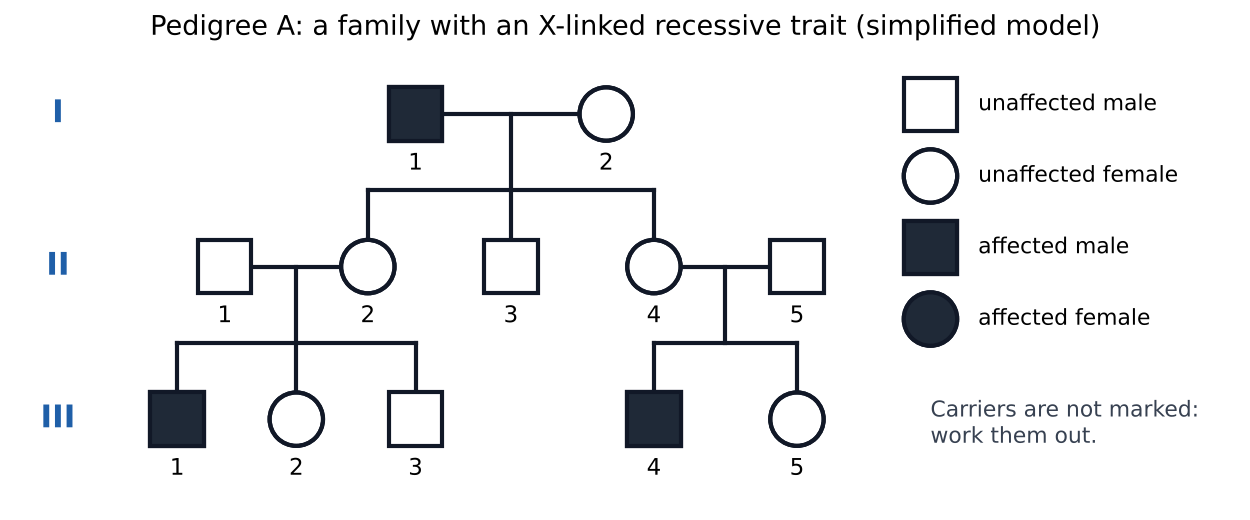
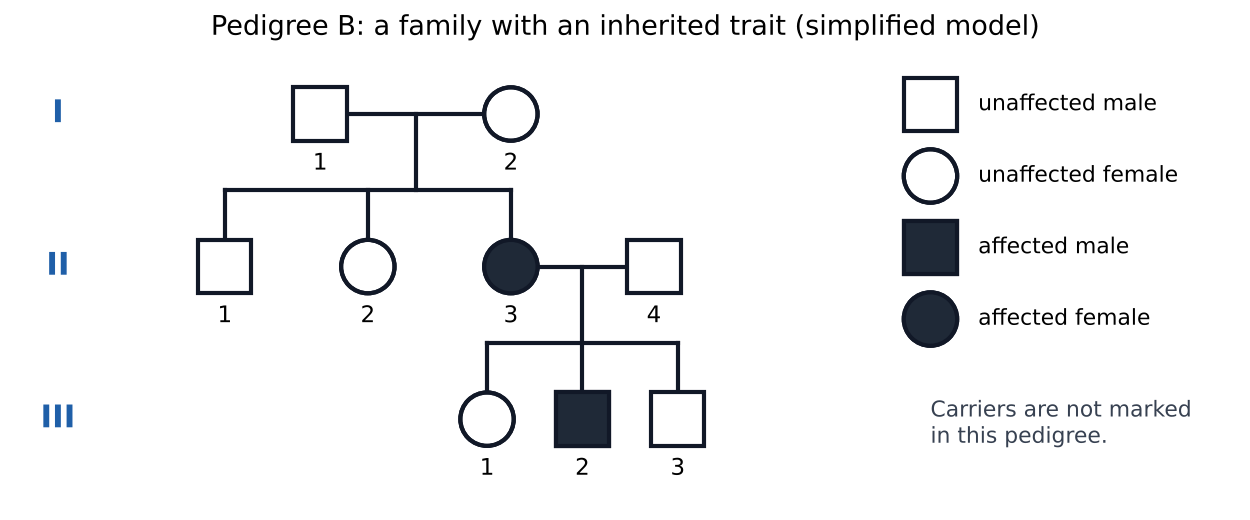
A pedigree is a family tree that shows who has a trait. Squares are males, circles are females, shaded means affected, half-shaded (if used) means carrier. A line between a male and a female joins parents, and the line down leads to their children. Generations are numbered with Roman numerals (I, II, III) and people with numbers, so II-4 is the 4th person in generation II.
Clues for deciding the pattern:
| Clue in the pedigree | What it suggests |
|---|---|
| Two unaffected parents have an affected child | recessive (both parents carry it) |
| Every affected person has at least one affected parent; two affected parents have an unaffected child | dominant |
| Mostly males affected; passed from a man through his daughters to grandsons; never father → son | X-linked recessive |
| An affected daughter has an unaffected father, or an affected mother has an unaffected son | not X-linked recessive, so autosomal |
| Males and females affected about equally; father → son passing happens | autosomal |
Worked example: genotypes in Pedigree A
Pedigree A shows an X-linked recessive trait. Write the genotypes of I-1, II-2, II-3 and III-1.
Start with the affected people, then work outwards.
- I-1 is an affected male: XaY.
- II-2 is his daughter. Carriers are not marked, so work it out: every daughter gets her father's X, so she must have his Xa. She is unaffected, so her other X is XA: XAXa (carrier). Her affected son III-1 backs this up.
- II-3 is his son. Sons get Dad's Y, not his X, so II-3 got his X from his mother: XAY, unaffected. This is the "never father → son" clue.
- III-1 is an affected male. His Y came from his father (II-1), so his Xa came from his carrier mother II-2: XaY.
Evaluating a claim
To evaluate a claim, you judge how accurate it is using evidence. Don't just agree or disagree: break the claim into parts and test each one.
What a full answer includes:
- State the claim (and split it into its parts).
- Test each part against scientific evidence: genotypes, a Punnett square or a pedigree.
- Say which parts are accurate and which are inaccurate, with a reason for each.
- Give an overall judgement.
Worked example: "Red hair skips a generation, so it must be on the Y chromosome."
Evaluate this claim. (In a simple model, red hair is recessive and its main gene is on an autosome.)
1. Claim: (a) red hair skips a generation; (b) so the gene must be on the Y chromosome.
2–3. Part (a): partly accurate. Red hair is recessive, so two parents without red hair can both be carriers and have a red-haired child. It can look like it skips a generation. But it does not always skip: two red-haired parents usually have red-haired children.
Part (b): inaccurate. Only males have a Y. A Y-linked trait would appear only in males and pass from a father to every son, so it could not skip a generation of males. Red-haired females are common, so the gene cannot be on the Y. Skipping generations is evidence for a recessive allele, not for the Y chromosome.
4. Judgement: the observation is partly accurate, but the conclusion is inaccurate. The pattern fits an autosomal recessive trait.
Accurate or inaccurate? (pairs, 5 minutes)
For each statement, decide accurate or inaccurate and give a one-line reason. Use a Punnett square if it helps.
- A boy always inherits his X chromosome from his mother.
- A carrier female shows the X-linked recessive trait.
- X-linked recessive traits are more common in males.
- Every daughter of a man with an X-linked recessive trait carries the recessive allele.
- A woman can have an X-linked recessive trait.
Answers: 1 accurate (his father gave him a Y). 2 inaccurate (her XA hides the Xa). 3 accurate (one X, nothing to hide the allele). 4 accurate (every daughter gets her father's only X). 5 accurate, if she inherits Xa from both parents.
Guided example
Look at Pedigree B. Is the trait dominant or recessive? Is it X-linked recessive or autosomal?
Prompts: First look at I-1, I-2 and their daughter II-3. What does an affected child of two unaffected parents tell you? Then look at II-3's father (I-1) and her son III-3. If the trait were X-linked recessive, what would II-3's genotype be, and what would that mean for her father and her sons?
Show answer
Recessive: I-1 and I-2 are unaffected but their daughter II-3 is affected. Both parents must carry a hidden recessive allele (Aa × Aa).
Not X-linked: if it were X-linked recessive, II-3 would be XaXa. She gets one X from her father, so I-1 would be XaY and affected, but he is not. Also, every son of an XaXa mother gets an Xa and would be affected, but III-3 is unaffected.
Conclusion: autosomal recessive. II-3 is aa. Her partner II-4 is unaffected, but their son III-2 is affected (aa), so II-4 must be Aa.
Self-check
How this works
Pick an answer to get feedback. Nothing is saved or sent anywhere; this is just for you.
1.
Why are X-linked recessive traits more common in males than in females?
Explanation
Male = XY: one X, so whatever allele is on it shows. Female = XX: she needs the recessive allele on both Xs to show the trait.
2.
In fruit flies, red eyes (XR) are dominant to white eyes (Xr). A homozygous red-eyed female (XRXR) is crossed with a white-eyed male (XrY). What % of the daughters are expected to be carriers? (Type a number only.)
Worked solution
Every daughter gets Dad's only X, which is Xr, and an XR from Mum. So every daughter is XRXr: red-eyed carriers, 100%. (The sons get Mum's XR and Dad's Y, so they are all red-eyed.)
3.
Use Pedigree A (an X-linked recessive trait).
What is the genotype of II-4?
Explanation
Daughters of an affected father always receive his Xa. If unaffected, they are carriers (XAXa).
4.
Use Pedigree B. The trait is recessive.
Which evidence in Pedigree B shows that the trait is not X-linked recessive?
Explanation
For an X-linked recessive trait, an affected female's father and all her sons must be affected. II-3's father (I-1) and her son III-3 are unaffected, so the trait cannot be X-linked recessive. It is autosomal recessive.
5.
A female fruit fly has the genotype XRXr (red eyes XR are dominant to white eyes Xr). Which describes her?
Explanation
A carrier has one copy of a recessive allele hidden by a dominant one. For X-linked traits, only females (XX) can be carriers: males have one X, so they either show the trait or do not have the allele.
Exam skill: Sex-linked crosses, pedigrees and evaluating claims
What a full answer includes
- Sex-linked cross: both parents' genotypes written with X and Y (e.g. XAXa, XAY); a Punnett square; the % for the group asked (sons, daughters or all offspring)
- Pedigree: start from affected people; use the clues (two unaffected parents with an affected child → recessive; affected female with an unaffected father or son → not X-linked); name the person (e.g. II-3) when you use them as evidence
- Evaluate a claim: state the claim and split it into parts; test each part with evidence; say which parts are accurate or inaccurate and why; give an overall judgement
Worked example
Worked example: sex-linked cross. Duchenne muscular dystrophy (DMD) is X-linked recessive. A woman who is a carrier and a man who does not have DMD are planning a family. What are the chances for their sons and daughters?
Parents: XAXa × XAY.
| XA | Y | |
| XA | XAXA | XAY |
| Xa | XAXa | XaY |
Father's gametes across, mother's down.
Daughters: XAXA or XAXa: 0% affected, 50% chance of being a carrier. Sons: XAY or XaY: 50% chance each son has DMD. All children: 1 in 4 = 25%.
Families in this situation can talk to a genetic counsellor, who explains these chances and the options available.
Guided (use the prompts)
2.
In fruit flies, red eyes (XR) are dominant to white eyes (Xr). Morgan crossed a white-eyed female with a red-eyed male.
Prompts: First write each parent's genotype using XR, Xr and Y. Then put each parent's gametes along the top (male) and side (female), and fill in the offspring.
In the boxes, XR is shown as Xᴿ and Xr as Xʳ.
blue = gametes from the red-eyed male · pink = gametes from the white-eyed female
Order rule: put the capital letter before the lower-case letter, and X before Y.
Worked solution
Female white-eyed = XrXr (gametes Xr, Xr). Male red-eyed = XRY (gametes XR, Y). Every daughter gets Dad's XR and Mum's Xr: XRXr. Every son gets Mum's Xr and Dad's Y: XrY.
Guided (use the prompts)
3.
Use your square for the white-eyed female (XrXr) × red-eyed male (XRY).
Daughters: all have eyes, and they are .
Sons: all have eyes, because a son's X chromosome comes from his .
Worked solution
All daughters are XRXr: red-eyed carriers (they get Dad's XR). All sons are XrY: white-eyed, because their only X comes from Mum, who has only Xr.
Guided (use the prompts)
4.
For the same cross, white-eyed female (XrXr) × red-eyed male (XRY), what % of the sons have white eyes? (Type a number only.)
Prompt: where does a son's X come from?
Worked solution
A son's X comes from his mother, and she only has Xr. So 100% of sons are XrY (white).
Guided (use the prompts)
5.
Evaluate the claim: "White eyes in fruit flies only ever appear in males."
Prompts: First state the claim. Then ask: what genotype would a white-eyed female need, and which allele must each parent give her? Then test it: what do you get if you cross a white-eyed female (XrXr) with a white-eyed male (XrY)? Finally, say what is accurate, what is inaccurate, and give a judgement.
Model answer
Claim: only male fruit flies can have white eyes.
Evidence: a white-eyed female would be XrXr, with one Xr from each parent. Crossing a white-eyed female (XrXr) with a white-eyed male (XrY) gives only XrXr daughters and XrY sons, so every offspring has white eyes, daughters included.
Accurate part: white eyes are more common in males, because a male needs only one Xr.
Inaccurate part: "only ever". A female has white eyes if she inherits Xr from both parents.
Judgement: inaccurate. It is based on a real pattern, but over-generalises it.
Your turn
6.
A carrier woman (XAXa) and an unaffected man (XAY) have a family. What % of their daughters are expected to be carriers? (Type a number only.)
Worked solution
Every daughter gets XA from her father, and XA or Xa from her mother. So daughters are XAXA or XAXa: 50% are expected to be carriers.
Your turn
7.
Evaluate the claim: "Because a girl's father has an X-linked recessive condition, she will definitely have it too."
Model answer
Claim: a daughter of an affected father will definitely be affected.
Evidence: the father is XaY. Every daughter gets her father's X, so she always inherits Xa. Whether she is affected depends on the X from her mother: if the mother is XAXA, every daughter is an unaffected carrier; if the mother is XAXa, each daughter has a 50% chance of being affected; only if the mother is XaXa is it 100%.
Accurate part: she always inherits her father's recessive allele.
Inaccurate part: she will not "definitely" have the condition. One XA from her mother hides the Xa.
Judgement: inaccurate. She always inherits her father's recessive allele, but she is affected only if she also inherits a recessive allele from her mother.
Exit questions
- Write the genotype of a carrier female and an affected male for an X-linked recessive trait.
- In a pedigree, what is the clue that a trait is recessive?
- Why can a female be a carrier of an X-linked recessive trait, but a male cannot?
Show answers
- Carrier female XAXa; affected male XaY.
- Two unaffected parents have an affected child, so both parents must carry the hidden recessive allele.
- A female has two X chromosomes, so a dominant allele on one can hide the recessive allele on the other. A male has only one X, so if it carries the recessive allele he shows the trait.