The big bang: evidence, timeline and the fate of the universe
AC9S10U03 AC9S10H02 AC9S10I05 AC9S10I08
By the end of this lesson you should be able to
- Describe what the big bang theory says, and explain why it was not an explosion into space.
- Explain how the expansion of the universe, the cosmic microwave background and the amounts of hydrogen and helium support the theory.
- Explain why the steady state theory was rejected.
- Make a justified prediction about the future of the universe, including what new evidence could change it.
Hook
Rewind the movie. Yesterday we saw that galaxies are moving apart, and the farther away they are, the faster they go.
Imagine filming the universe and playing it backwards.
- What happens to the distances between galaxies?
- What happens to the matter and energy as they are squeezed together? (Think: what happens to a bike pump when you squash the air in it?)
- If you know how fast things are separating and how far apart they are, what could you work out?
Write a one-line prediction before the video.
Watch: The Big Bang, Cosmology part 1: Crash Course Astronomy #42 · Crash Course
What the theory actually says
Run the expansion backwards and everything gets closer together, hotter and denser. The big bang theory says:
- About 13.8 billion years ago, the whole observable universe was in an extremely hot, dense state.
- Since then, space itself has been expanding and the universe has been cooling.
- As it cooled, particles, then atoms, then stars and galaxies formed.
Three things it does not say:
- Not an explosion into empty space. There was no outside to explode into. The expansion happened everywhere at once; every point moved apart from every other point.
- Not a centre. The big bang did not happen at one place in space. It happened to all of space.
- Not the very first instant. The theory is well tested from a tiny fraction of a second after the start. What happened at time zero, or "before", is still an open question.
Key idea: the big bang is the expansion and cooling of a hot, dense early universe, happening everywhere. The name comes from Fred Hoyle, a critic of the theory, on BBC radio in 1949. He is often said to have used "big bang" as a put-down (he later denied mocking it). Either way, it stuck.
Three lines of evidence
Evidence 1: the universe is expanding. Redshift shows galaxies moving apart, faster the farther away (last lesson). If they are moving apart now, they were closer together in the past.
Evidence 2: the cosmic microwave background (CMB). For about 380 000 years, the universe was so hot that light could not travel far: it kept bouncing off free electrons, like light in fog. When it cooled to about 3000 K, atoms formed, the fog cleared, and that light has been travelling ever since. Expansion has stretched it from visible and infrared light into microwaves, now matching a temperature of just 2.7 K (−270 °C). It comes from every direction.
In 1965, Arno Penzias and Robert Wilson were testing a large horn-shaped radio antenna in the USA and found a faint hiss they could not get rid of. They even cleaned out pigeon droppings (and evicted the pigeons). The hiss stayed, from every direction, day and night. It was the CMB, predicted by big bang scientists in the 1940s. They shared the 1978 Nobel Prize. Satellites have since mapped it in detail: COBE (1989), WMAP (2001) and Planck (2009).
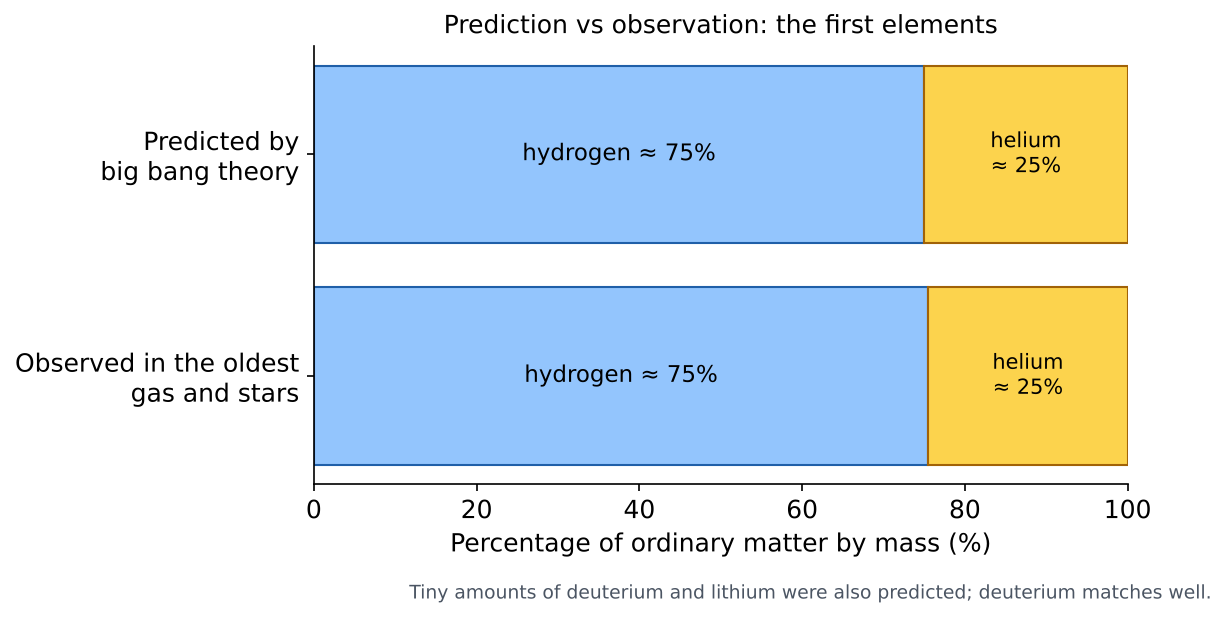
Evidence 3: the amounts of light elements. In the first few minutes, the universe was hot enough for nuclear fusion, but only briefly. The theory predicts this made ordinary matter about 75% hydrogen and 25% helium by mass, with tiny traces of others. The oldest gas and stars match this.
The rival theory that lost: steady state
In 1948, Hermann Bondi, Thomas Gold and Fred Hoyle proposed the steady state theory. The universe expands, but it has no beginning: new matter is created very slowly to fill the gaps, so the universe always looks the same.
It was a good scientific theory, because it made testable predictions. They turned out wrong:
- No CMB. Steady state predicts no leftover glow from a hot past. Penzias and Wilson found one.
- The distant universe looks different. Looking far away means looking back in time. Distant (early) regions contain far more quasars (very bright, young galaxy cores) and young, small galaxies than nearby regions. A steady state universe should look the same at all times.
- Helium. Stars alone cannot make as much helium as we observe. The big bang explains it.
This is science working well: two theories, testable predictions, and the evidence decides.
A timeline, and how it might end
The width of the shape shows the size of the universe. Its ages come from the WMAP satellite (for example, afterglow light at about 375 000 years). Later measurements by the Planck satellite give slightly different values, which are the ones used below. Science updates its numbers as the measurements get better.
0
first few minutes
about 380 000 years
about 100–200 million years
billions of years
9.2 billion years (4.6 billion years ago)
13.8 billion years
Not to scale.
Will the expansion ever stop? Gravity pulls everything together, so astronomers expected the expansion to be slowing down. In 1998, two teams measuring distant exploding stars (supernovae) found the opposite: the expansion is speeding up. One team was led by Brian Schmidt at the Australian National University (Nobel Prize 2011). Whatever causes this is called dark energy. We do not yet know what it is.
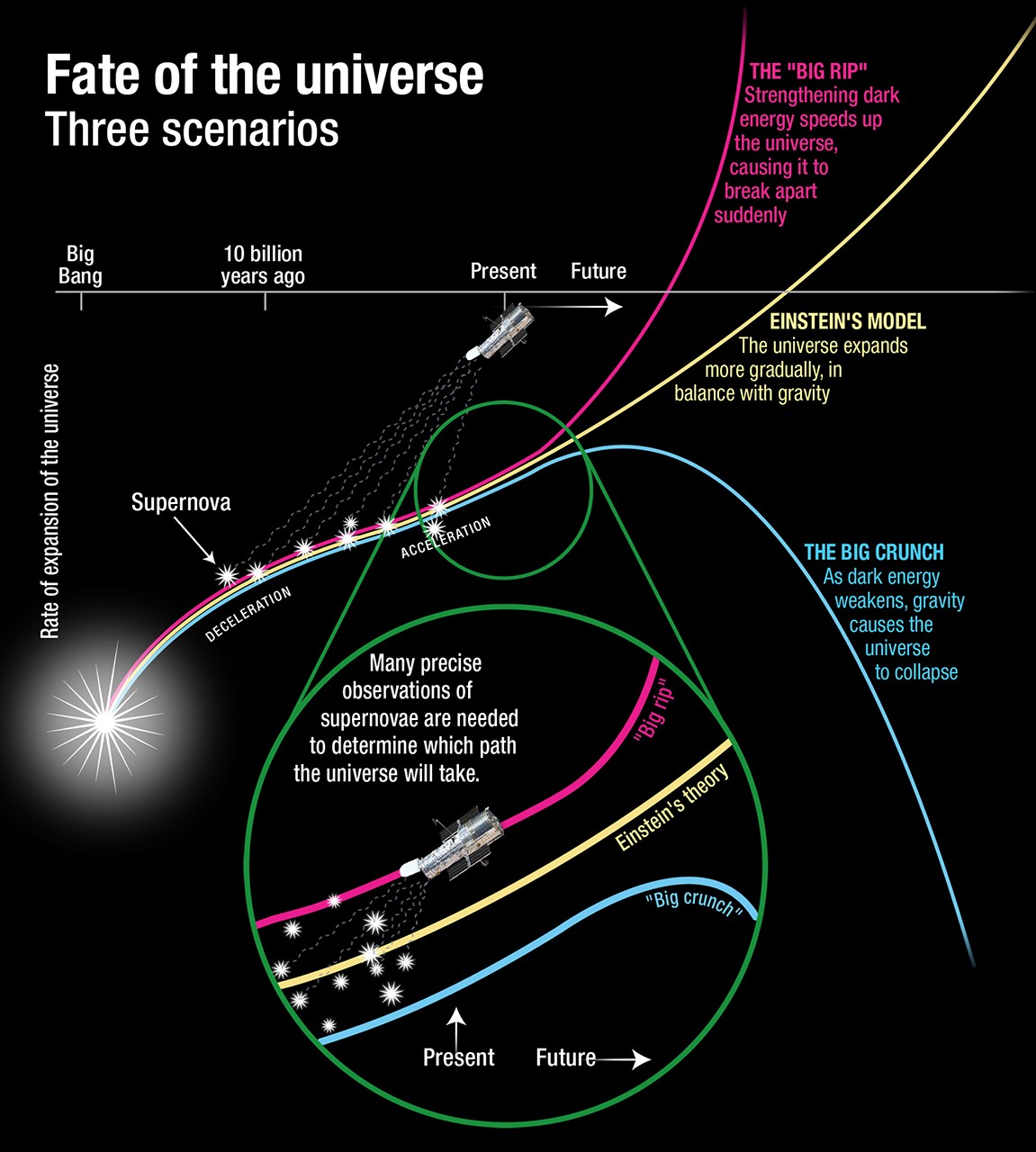
The NASA graphic shows three paths. The middle one, labelled Einstein's model, is steady expansion that carries on forever: that leads to the Big Freeze below.
- Big Freeze (heat death): expansion continues forever. Galaxies drift out of sight, stars burn out, everything cools towards absolute zero. This fits the current evidence best.
- Big Rip: dark energy gets stronger and eventually tears apart galaxies, stars and even atoms.
- Big Crunch: expansion stops and reverses, and everything collapses. This would need gravity to win, or dark energy to fade and change sign.
What would decide it? Measuring whether dark energy stays constant over time, using more supernovae, galaxy maps and the CMB. Recent large surveys have found hints that dark energy may be changing, so this is an active question.
Evidence card sort
On cards (or a table), sort these statements into supports big bang, supports steady state, or supports both:
- Distant galaxies are redshifted.
- A faint microwave glow comes from every direction in the sky.
- Ordinary matter is about 25% helium by mass.
- There were more quasars billions of years ago than there are now.
- The universe is expanding.
Then: which single card was most decisive in deciding between the theories? Justify your choice in two sentences.
Answers: 1 and 5 support both (both theories include expansion); 2, 3 and 4 support only the big bang. The CMB (card 2) is usually seen as decisive, because steady state has no way to explain it.
Try it
See the CMB on an old TV? On old analogue TVs, a small part of the "snow" between channels was CMB microwaves picked up by the aerial. Today, look at the Planck map of the CMB (link below). The colours show differences of only about 1 part in 100 000 in temperature.
Think: those tiny hotter and colder spots were slightly denser and less dense regions. What would gravity do to the denser regions over hundreds of millions of years? (Look at the timeline in section 4.)
ESA: Planck and the cosmic microwave background · NASA WMAP: Universe 101
Guided example
A friend says: "The big bang happened at one spot, and now everything is flying away from that spot. If we could find it, we'd find the centre of the universe." Use the evidence to explain what is wrong with this idea.
Show answer
Step 1: what do the observations show? Galaxies in every direction are moving away from us, faster the farther away. The CMB arrives from every direction, almost the same temperature everywhere (differences of about 1 part in 100 000).
Step 2: what would a "one spot" explosion predict? We would see galaxies moving away from a particular point, and the CMB would be brighter from one direction (towards the spot) than others.
Step 3: compare. The observations do not match that. They match space expanding everywhere at once, which looks the same from every galaxy (raisin bread). So there is no centre to find: every place in the universe was part of the hot, dense early state.
Self-check
How this works
Pick an answer to get feedback. Nothing is saved or sent anywhere; this is just for you.
1.
Where in the universe did the big bang happen?
Explanation
The big bang happened everywhere at once. That is why the CMB fills the whole sky and why every galaxy sees others receding.
2.
The cosmic microwave background was released when the universe was about 380 000 years old and much hotter. Why do we detect it as microwaves today?
Explanation
Stretching space stretches light. The CMB's wavelength has been stretched about 1100 times, cooling it to 2.7 K.
3.
Which observation could the steady state theory NOT explain?
Explanation
Good tests compare what each theory predicts. Both predict expansion; only the big bang predicts a CMB and an early universe that looks different.
4.
The universe is about 13.8 billion years old. The Sun and Earth formed about 4.6 billion years ago. How many billion years after the big bang did the Sun form?
Worked solution
13.8 − 4.6 = 9.2 billion years after the big bang. So the Sun is not one of the first stars: it formed from gas that already contained elements made by earlier generations of stars.
5.
In 1998, astronomers found that the expansion of the universe is speeding up. If dark energy stays about the same in the future, which outcome is most consistent with this evidence?
Explanation
Accelerating expansion points to a Big Freeze. A Big Rip would need dark energy to get stronger; a Big Crunch would need it to fade. Measuring how dark energy changes over time is how scientists will decide.
Exam skill: Justified prediction
What a full answer includes
- Prediction: a clear statement of what will happen
- Evidence: data or observations, with units where there are numbers
- Reasoning: the science that links the evidence to the prediction
- What could change it: an assumption you made, or new evidence that would change your prediction
Worked example
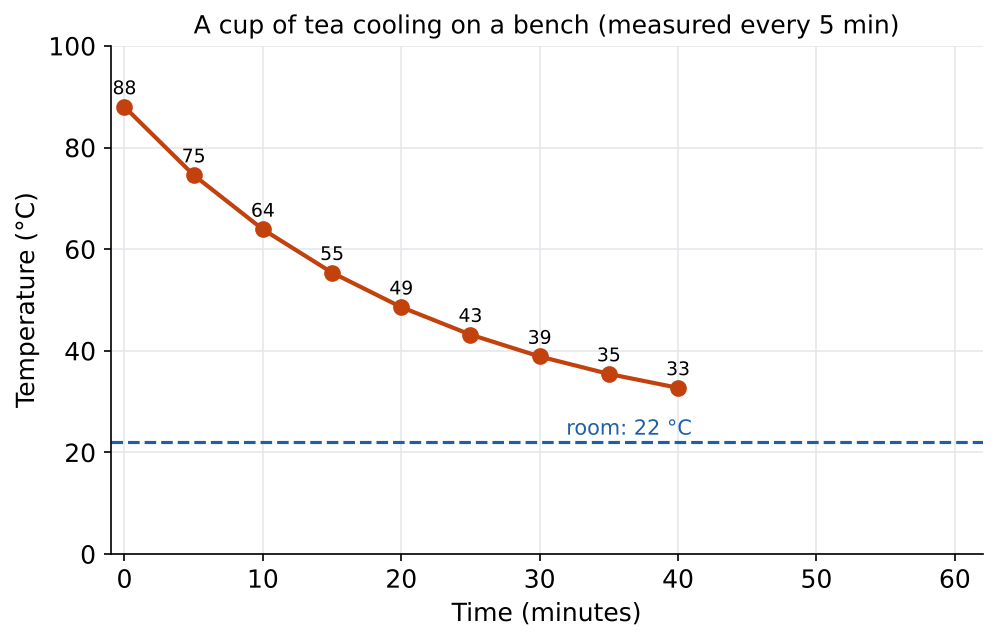
Worked example (an everyday context). A cup of tea is left on a bench in a 22 °C room. Its temperature is measured every 5 minutes.
Question: Make a justified prediction of the tea's temperature after 60 minutes.
Prediction: After 60 minutes the tea will be about 26 °C: close to, but slightly above, room temperature.
Evidence: The tea cooled from 88 °C to 64 °C in the first 10 minutes (a drop of 24 °C), but only from 43 °C to 33 °C between 25 and 40 minutes (a drop of 10 °C in 15 minutes). The curve is levelling off as it approaches the room temperature of 22 °C.
Reasoning: Heat flows from the hot tea to the cooler room. The smaller the temperature difference, the slower the heat flows, so the cooling slows down. The tea can cool towards 22 °C but not below it. Following the flattening curve another 20 minutes gives a value in the mid-20s.
What could change it: I assumed the room stays at 22 °C and nothing else changes. If someone added milk, put a lid on, or the air-conditioning came on, the prediction would change.
Guided (use the prompts)
2.
The star Alpha Centauri A has about 1.1 times the mass of the Sun and is a main-sequence star fusing hydrogen in its core. Make a justified prediction about how its life will end. (Use the star life cycle from the scale and life cycles lesson.)
- Prediction: what stages will it go through, and what will be left at the end?
- Evidence: what do we know about this star (mass, current stage)?
- Reasoning: why does mass decide a star's fate? What happens when core hydrogen runs out?
- What could change it: what if the mass measurement were very wrong?
Model answer
Prediction: Alpha Centauri A will swell into a red giant, puff off its outer layers as a planetary nebula, and end as a white dwarf. It will not explode as a supernova.
Evidence: It has about 1.1 times the Sun's mass and is on the main sequence, fusing hydrogen in its core, like the Sun.
Reasoning: Mass decides a star's fate. When core hydrogen runs out, the core shrinks and heats up while the outer layers expand and cool: a red giant. Only stars of more than about 8 times the Sun's mass end in a supernova. A low-mass star like this one loses its outer layers gently and leaves its hot core behind as a white dwarf.
What could change it: only a huge error in the mass. It would need to be more than about 8 times the Sun's mass to end as a supernova, which is very unlikely for a star so similar to the Sun.
Extension (not needed): Alpha Centauri A has a companion star, Alpha Centauri B. Stars that orbit very close together can swap material and change each other's endings, but these two are far enough apart that this is not expected.
Your turn
3.
Today the cosmic microwave background (CMB) has a temperature of 2.7 K. When it was released, about 380 000 years after the start, it was about 3000 K. Since then the universe has expanded about 1100 times.
Fact you need: as space expands, the CMB's wavelengths are stretched and its temperature falls in step. If distances in the universe double, the CMB temperature halves.
Predict what will happen to the temperature of the CMB over the next tens of billions of years, and justify your prediction.
Model answer
Prediction: The CMB will keep getting colder, closer and closer to absolute zero (0 K) without quite reaching it. Its wavelengths will keep getting longer.
Evidence: The CMB has cooled from about 3000 K to 2.7 K while the universe expanded about 1100 times (3000 ÷ 1100 ≈ 2.7, which fits the fact in the box). Redshift measurements show the universe is still expanding, and since 1998 the evidence shows the expansion is speeding up.
Reasoning: Expanding space stretches the CMB to longer wavelengths, and its temperature falls in step: if distances double, the temperature halves (2.7 K → about 1.35 K). Because the expansion is continuing, the CMB will keep cooling.
What could change it: this assumes the expansion continues. If it ever reversed (a Big Crunch), the CMB would be squeezed to shorter wavelengths and would heat up again.
Exit questions
- List the three main lines of evidence for the big bang theory.
- Why is "the big bang was an explosion into empty space" incorrect?
- What did astronomers discover in 1998, and what name do they give its unknown cause?
Show answers
- The expansion of the universe (redshift of galaxies, farther = faster); the cosmic microwave background; the amounts of light elements (about 75% hydrogen, 25% helium by mass).
- There was no empty space outside to explode into. Space itself has been expanding everywhere at once, so there is no centre and no edge.
- That the expansion of the universe is speeding up (from distant supernovae). The cause is called dark energy.
Want more?
- Kurzgesagt: The Beginning of Everything – The Big Bang
- Crash Course Astronomy #43: Dark Energy, Cosmology part 2
- ESA: Planck and the cosmic microwave background