Redshift and the expanding universe
AC9S10U03 AC9S10H02 AC9S10I05 AC9S10I08
By the end of this lesson you should be able to
- Describe the Doppler effect for sound and for light, using the words wavelength, redshift and blueshift.
- Explain how a shift in a galaxy's absorption lines tells us whether it is moving away from us or towards us.
- Describe the trend in a Hubble-style graph and quote data points with units.
- Write a justified explanation (claim + evidence + reasoning) for why the data show that space is expanding.
Hook
Close your eyes. An ambulance is coming down the street with its siren on. It passes you and drives away.
- What happens to the pitch of the siren as it passes?
- The siren itself never changed. So what did?
Try it: put a small buzzer (switched on) inside a foam ball or a rolled-up sock and gently throw it back and forth between two people, or roll it past the class. Listen to the pitch as it comes towards you and goes away.
Big question for today: could the same thing happen to light? And what would it tell us about galaxies millions of light-years away?
Watch: Galaxies, part 2: Crash Course Astronomy #39 · Crash Course
The Doppler effect: sound first
A sound source sends out waves. Each crest spreads out like a ripple. If the source is still, the crests are evenly spaced in every direction.
If the source is moving, it chases the waves in front of it and runs away from the waves behind it.
- In front: crests are squashed together. Shorter wavelength (distance between crests) → higher pitch.
- Behind: crests are stretched apart. Longer wavelength → lower pitch.
This change in wavelength caused by motion is the Doppler effect. The siren never changes. What you hear depends on whether the source is coming towards you or moving away.
Light does the same thing. In this NASA illustration, the middle spectrum is a star that is not moving towards or away from us. When the star moves towards us (top), its dark lines shift towards the blue end (blueshift). When it moves away (bottom), they shift towards the red end (redshift).

Light does it too: redshift and blueshift
Light is also a wave. For visible light, wavelength shows up as colour: red light has the longest wavelength, violet the shortest.
- A light source moving away from us has its wavelengths stretched. Everything shifts towards the red end: redshift.
- A source moving towards us has its wavelengths squashed: blueshift.
A galaxy does not suddenly look red. The shift is small. So how can we measure it? We use the absorption lines from our spectroscopy practical. Hydrogen always absorbs at the same wavelengths in a lab (656 nm, 486 nm and 434 nm in visible light). In a galaxy's spectrum we find the same pattern of lines, with the same spacing ratios, but slid along towards the red.
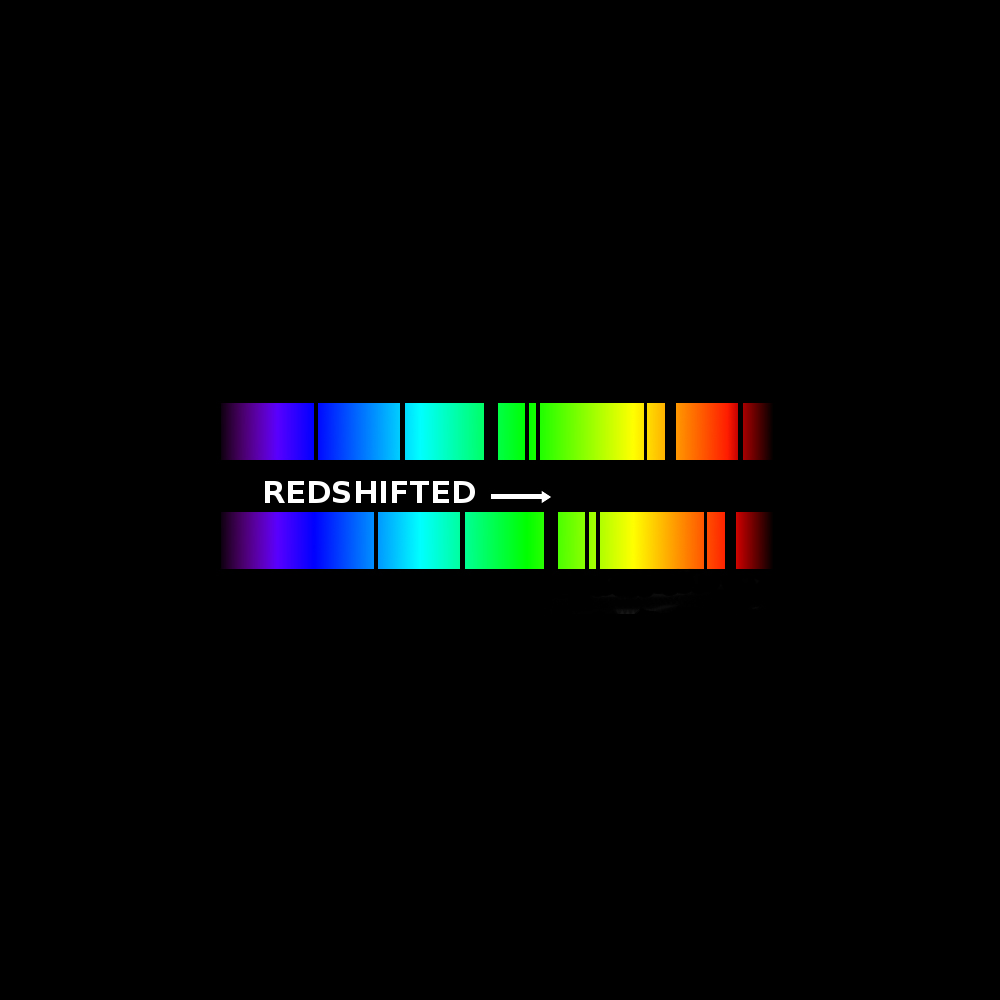
Top: absorption lines from a source that is not moving relative to us. Bottom: the same pattern of lines from a galaxy moving away: every line has slid towards the red (longer wavelength). Look at the spacing: the pattern is the same, only its position has changed.
Key idea: same pattern of lines + shifted to longer wavelengths = the source is moving away from us. The bigger the shift, the faster it is moving away.
Worked example: reading a shift
In the lab, a hydrogen line is at 656 nm. In a galaxy's spectrum the same line is at 689 nm. Is the galaxy moving towards us or away? Roughly how big is the shift, as a percentage?
689 nm is longer than 656 nm, so the line has shifted towards red: redshift. The galaxy is moving away from us.
Shift = 689 − 656 = 33 nm. 33 ÷ 656 ≈ 0.05, so about 5%. (For speeds much less than light, 5% of the speed of light is about 15 000 km/s.)
Hubble: farther galaxies are moving away faster
This discovery took several people:
- Henrietta Leavitt (1912) found that a type of pulsing star, a Cepheid, has a brightness linked to how fast it pulses. That made Cepheids "standard candles" for measuring distance.
- Vesto Slipher (1912–1917) measured the spectra of fuzzy "spiral nebulae" and found that most were redshifted, some by huge amounts.
- Edwin Hubble used Cepheids to show these nebulae are separate galaxies, far outside the Milky Way. In 1929 he plotted their distances against their speeds (from Slipher's and his own redshifts).
The pattern: almost every galaxy is moving away from us, and the farther away a galaxy is, the faster it is moving away. Speed is roughly proportional to distance.
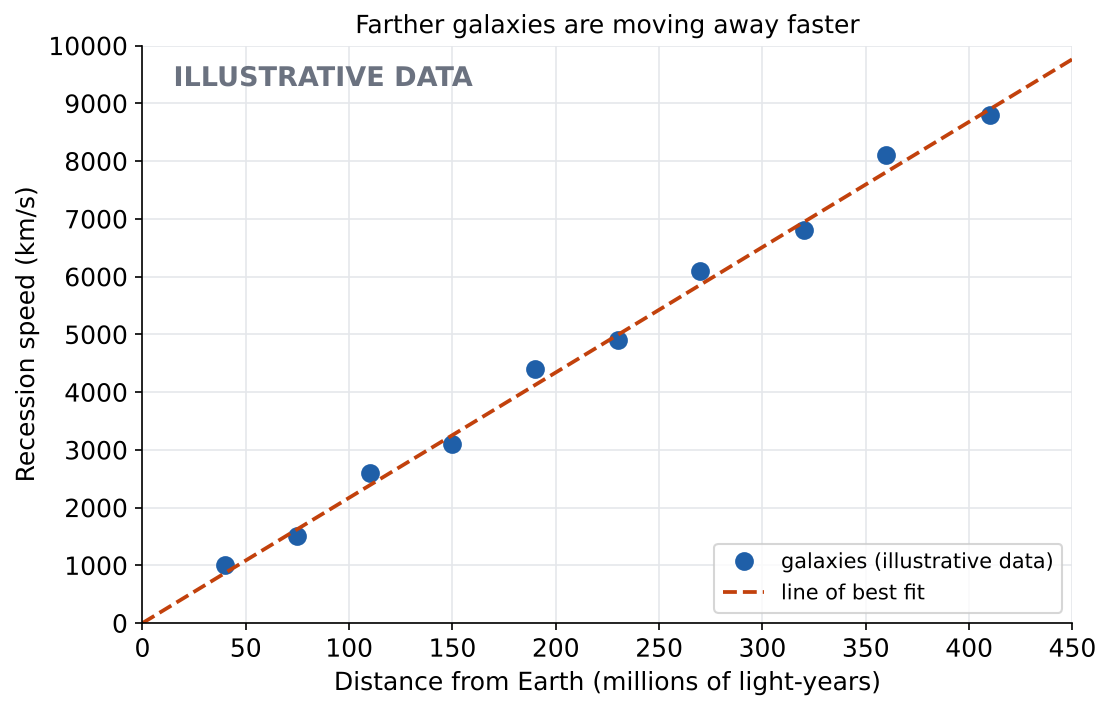
For this graph, the line rises about 22 km/s for every million light-years (the real value is close to this).
Credit where it is due: Belgian physicist and priest Georges Lemaître predicted an expanding universe from Einstein's theory of gravity and linked it to galaxy redshifts in 1927, two years before Hubble's graph.
Space itself is stretching
Why would far galaxies move away faster? Because space itself is expanding. Galaxies are not flying out through space from one spot. The space between them is growing.
The raisin bread model: raisins in rising dough. As the dough rises, every raisin moves away from every other raisin. A raisin twice as far away moves away twice as fast, because there is twice as much dough between them stretching. And from any raisin, all the others seem to move away. So seeing every galaxy recede does not mean we are at the centre.
Light travelling through stretching space gets stretched too. That is the best way to picture the redshift of distant galaxies.
Limits of the model:
- The loaf has an edge and a centre. As far as we know, the universe has neither.
- The loaf grows into the kitchen. Space is not expanding into anything.
- In the loaf, the dough pushes the raisins apart. In the universe nothing pushes the galaxies: the space between them grows. (One way the model does match: the raisins themselves do not grow, just as gravity holds galaxies, stars and you together so they do not stretch.)
- Nearby galaxies can still move towards us. Andromeda's gravity pulls it towards the Milky Way faster than the space between us grows.
Read the Hubble plot
Use the Hubble-style graph in section 3 (illustrative data). With a partner:
- Identify the trend in one sentence. Use the words "as … increases, …".
- Quote two data points with units, one near and one far. (e.g. "the galaxy at 75 million ly moves away at about 1500 km/s")
- Read the line: what speed would you expect for a galaxy 300 million light-years away? (About 6500 km/s.)
- Anomaly hunt: which point sits furthest from the line? Suggest one reason (hint: galaxies also move around inside their groups, and distances have uncertainty).
- Explain the trend using the raisin bread model.
Try it
Balloon universe: draw 5 dots on a deflated balloon with a marker and label one "us". Measure the distance from "us" to each dot with a strip of paper. Blow the balloon up a bit and measure again. Predict first: which dot's distance will grow the most? Was "us" special? Now label a different dot "us" and check.
Limit to notice: the dots are on the surface. The inside of the balloon is not part of the model universe.
NASA: Hubble and the expanding universe
Guided example
Most galaxies show redshift, but the Andromeda Galaxy (2.5 million light-years away) shows blueshift. Does this mean the universe is not expanding?
Show answer
No. Blueshift means Andromeda is moving towards us. As we see it from the Sun, it is approaching at about 300 km/s. Part of that is our own Sun's orbit around the Milky Way carrying us towards Andromeda; for the Milky Way as a whole, the approach is about 110 km/s.
At 2.5 million light-years, the Hubble trend predicts a recession speed of only about 2.5 × 22 ≈ 55 km/s. Andromeda and the Milky Way are close enough that their gravity pulls them together much faster than the space between them grows.
The expansion shows up in the pattern for distant galaxies, where it wins easily. One nearby exception does not overturn a trend measured across thousands of galaxies, and the exception has a good scientific explanation.
Self-check
How this works
Pick an answer to get feedback. Nothing is saved or sent anywhere; this is just for you.
1.
Astronomers find that the absorption lines in the spectrum of the Andromeda Galaxy are shifted slightly towards the blue end compared with a lab sample. What does this tell us?
Explanation
Same pattern of lines, shifted to shorter wavelengths (blueshift) = moving towards us. Shifted to longer wavelengths (redshift) = moving away.
2.
What does redshift mean?
Explanation
Redshift = the same pattern of lines, at longer wavelengths than in the lab. There are two causes. For a nearby object, it is a Doppler shift: the object is moving away from us through space. For distant galaxies, most of the redshift comes from the expansion of space stretching the light on its long journey to us.
3.
On a Hubble-style graph, the line of best fit passes through the origin (0, 0). If you imagine running the expansion backwards, what does this suggest?
Explanation
Run the expansion backwards and galaxies get closer together, so the early universe was much denser. This graph alone does not prove a beginning, but together with other evidence (the cosmic microwave background, the amounts of hydrogen and helium) it supports the big bang. The origin of the graph is not a centre in space: every galaxy would draw the same graph.
4.
Almost every distant galaxy is moving away from the Milky Way. A student says this proves the Milky Way is at the centre of the universe. Why is this not correct?
Explanation
Uniform expansion looks the same from every galaxy. Observers anywhere see distant galaxies receding (except nearby ones held by gravity), so seeing it does not put us at the centre.
Exam skill: Justified explanation
What a full answer includes
- Claim: a clear answer to the question in one sentence
- Evidence: the trend described AND at least two data points quoted from the graph, with units
- Reasoning: the science that links the evidence to the claim (why does this evidence support this claim?)
Worked example
Worked example (a different context). A car sounds its horn as it drives past a listener at a steady speed. The graph shows the pitch the listener hears.
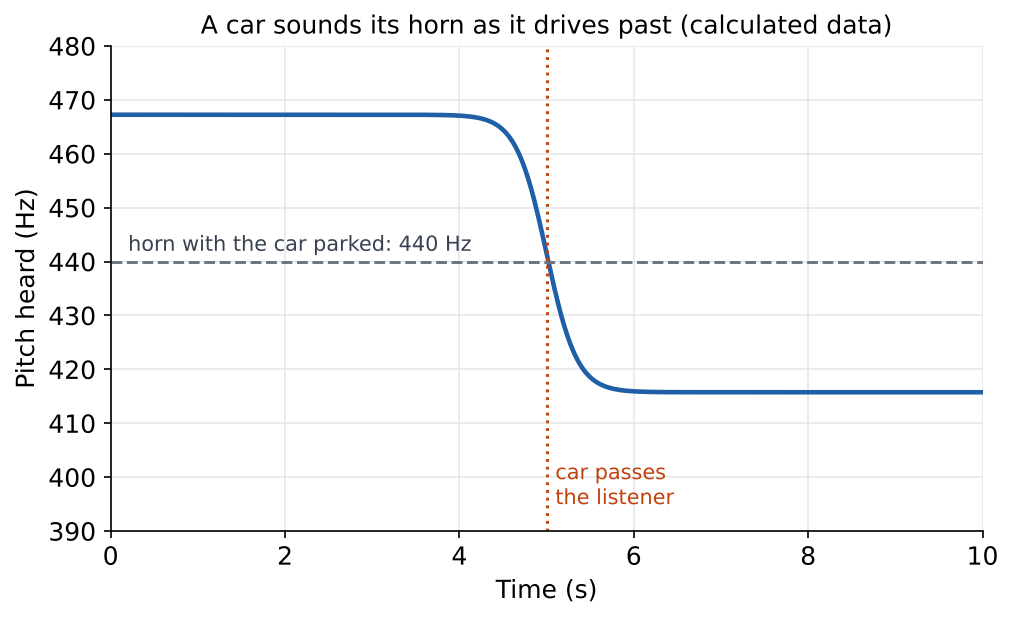
Question: Explain what the graph shows about the motion of the car.
Claim: The car was moving towards the listener for the first 5 seconds and away from the listener after that.
Evidence: Before 5 s the pitch heard is steady at about 467 Hz, which is higher than the 440 Hz the horn makes when the car is parked. After 5 s it drops to a steady 416 Hz, lower than 440 Hz. The pitch crosses 440 Hz at 5 s.
Reasoning: This is the Doppler effect. When a source moves towards a listener the sound waves are squashed, so the wavelength is shorter and the pitch is higher. When it moves away the waves are stretched and the pitch is lower. So higher-than-440 means approaching and lower-than-440 means receding, and the car passed the listener at 5 s.
Notice: every number has a unit, and the reasoning uses the science (wavelength squashed or stretched), not just "because the graph says so".
Guided (use the prompts)
2.
Look at the Hubble-style graph (illustrative data). Which sentence is the best evidence for the claim "the universe is expanding"?
Explanation
Strong evidence = the trend in words + at least two specific data points with units that show it.
Guided (use the prompts)
3.
Use the Hubble-style graph again (illustrative data).
Write a justified explanation of how these data support the idea that space is expanding. You may use these readings: a galaxy at 40 million light-years moving away at about 1000 km/s, and one at 410 million light-years at about 8800 km/s.
- Claim: start with "These data support …"
- Evidence: describe the trend, then quote the two points with units.
- Reasoning: how does redshift give the speed? Why would expanding space make farther galaxies recede faster? (Think: raisin bread.)
Model answer
Claim: These data support the idea that space is expanding, because farther galaxies are moving away faster.
Evidence: As distance increases, recession speed increases in a roughly straight line through the origin. A galaxy at 40 million light-years moves away at about 1000 km/s, while one at 410 million light-years (about 10 times farther) moves away at about 8800 km/s (about 9 times faster).
Reasoning: The speeds come from redshift: the galaxies' lines are shifted to longer wavelengths. If all the space between galaxies is stretching, a galaxy twice as far away has twice as much space between us growing, so it moves away about twice as fast. That gives speed in proportion to distance, which is the pattern in the graph.
Your turn
4.
An astronomer measures the wavelength of the hydrogen line (656.30 nm in the lab) in the light of ONE nearby star, every night for 16 nights (illustrative data).
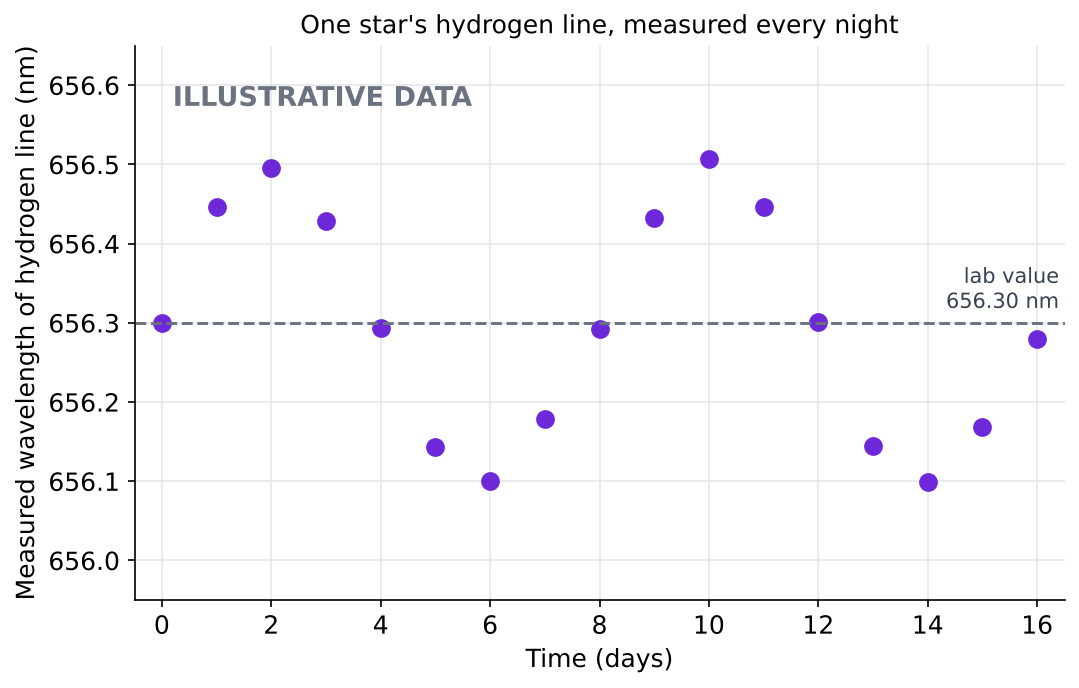
Use the graph to write a justified explanation of how this star is moving towards and away from us. Use the dashed lab value (656.30 nm) to decide when the light is redshifted and when it is blueshifted, and say how long one full cycle takes.
Model answer
Claim: The star moves alternately away from us and towards us, in a regular cycle that repeats every 8 days.
Evidence: The measured wavelength goes up and down around the lab value of 656.30 nm. On day 2 it is about 656.50 nm (longer than the lab value) and on day 6 it is about 656.10 nm (shorter). The highest values are on days 2 and 10 and the lowest on days 6 and 14, so one cycle takes 8 days.
Reasoning: A longer wavelength than in the lab is a redshift, so the star is moving away from us (around days 1–3 and 9–11). A shorter wavelength is a blueshift, so it is moving towards us (around days 5–7 and 13–15). At 656.30 nm (days 0, 4, 8, 12) it is moving neither towards nor away from us. Because the shifts swap back and forth in the same pattern, the motion repeats every 8 days.
Extension (not needed for full marks): a star that regularly moves towards and away from us is probably orbiting something, such as an unseen companion star or a large planet. This is one way astronomers find planets around other stars.
Exit questions
- A galaxy's hydrogen line, normally at 486 nm, is measured at 501 nm. Moving towards or away from us? How do you know?
- Name one person (other than Hubble) whose work was needed for Hubble's 1929 discovery, and what they contributed.
- Give one way the raisin bread model of the universe is not like the real universe.
Show answers
- Away from us: 501 nm is longer than 486 nm, so the line is redshifted (wavelength stretched).
- Henrietta Leavitt: the Cepheid brightness–period link that let distances be measured. Or Vesto Slipher: the first redshift measurements of spiral nebulae (galaxies).
- Any one: the loaf has an edge and a centre (the universe has neither, as far as we know); the loaf expands into the kitchen (space does not expand into anything); the dough is a substance, but space is not.